Restaurant Recipe Costing in Iraq: POS and Inventory Guide
A practical guide for Iraq restaurants, cafes, bakeries, and production kitchens that need recipe costing, raw material deduction, menu pricing, and reports.
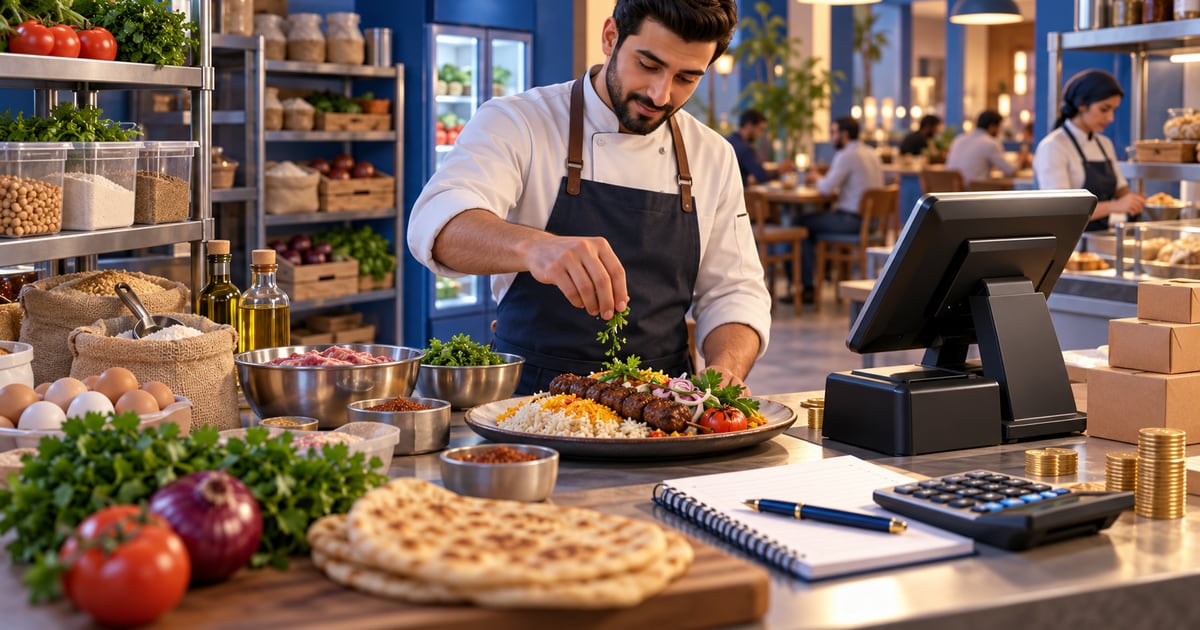
Restaurant recipe costing calculates the raw material cost behind each menu item. For Iraq restaurants, cafes, bakeries, and production kitchens, the useful workflow connects recipes, POS sales, ingredient deduction, purchases, waste, menu pricing, and reports so owners know whether a meal is profitable before and after it is sold.
01
Restaurant Recipe Costing in Iraq: POS and Inventory Guide
A restaurant can sell a popular item all day and still lose money if ingredient cost, waste, and portion size are not controlled. Recipe costing gives the owner a clearer view of what each plate, cup, box, or bakery item really costs.
Quick answer: Restaurant recipe costing calculates the raw material cost behind each menu item. For Iraq restaurants, cafes, bakeries, and production kitchens, the useful workflow connects recipes, POS sales, ingredient deduction, purchases, waste, menu pricing, and reports so owners know whether a meal is profitable before and after it is sold.
02
What recipe costing means
Recipe costing starts with a formula: one menu item uses specific quantities of raw materials. A burger may use bread, meat, sauce, cheese, vegetables, packaging, and maybe a side item. A latte uses coffee, milk, cup, lid, and sugar. A bakery item uses flour, butter, sugar, filling, packaging, and labor-related preparation time.
The software does not replace kitchen judgment, but it makes the business math visible. If supplier prices change and the recipe is not updated, the menu may look profitable while margin quietly disappears.
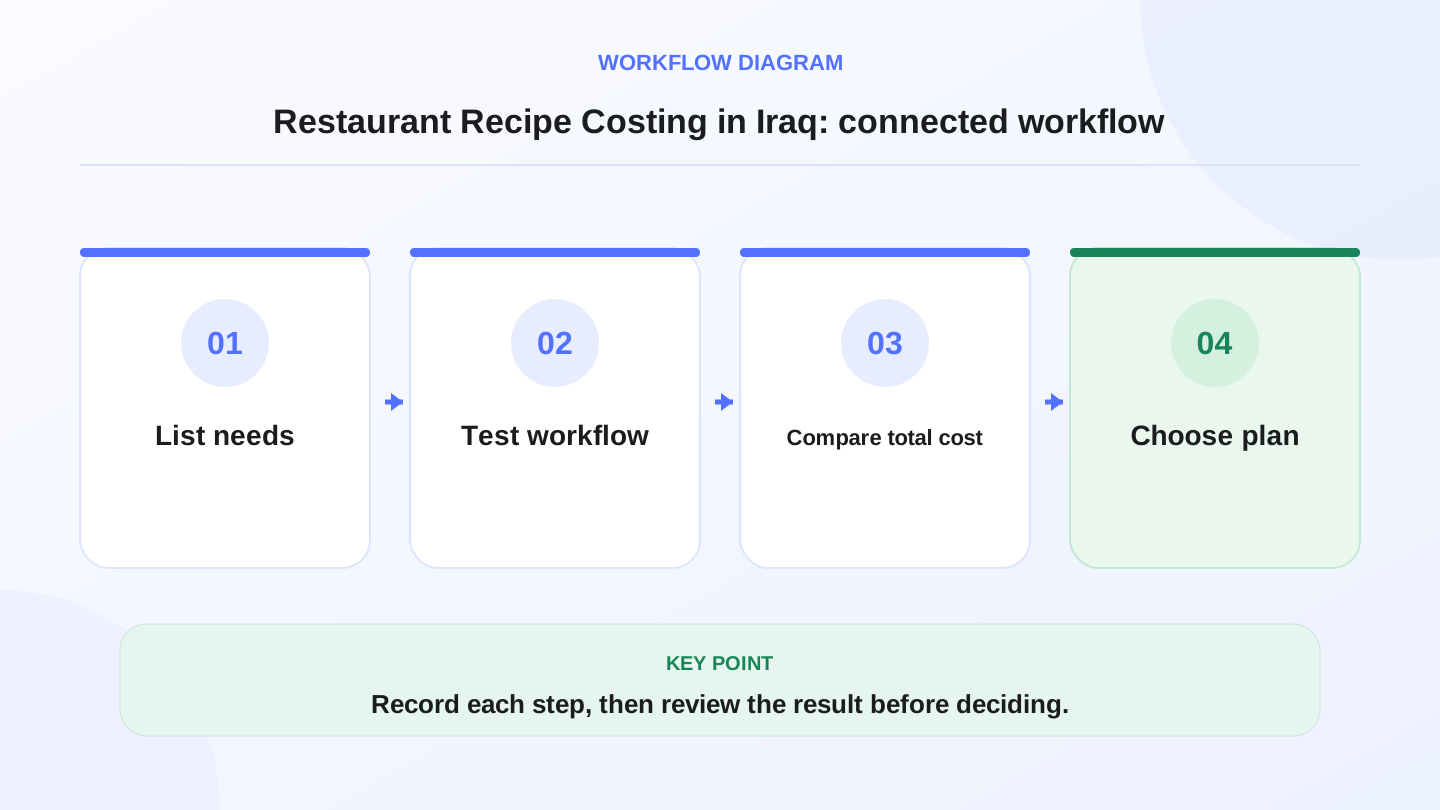
A practical sequence has four connected steps: List needs, Test workflow, Compare total cost, Choose plan. Recording each step makes the daily result easier to review.
03
Why restaurants in Iraq need tighter food cost control
Restaurants and cafes in Iraq often deal with price changes, supplier differences, cash purchases, delivery orders, and busy shifts. A small change in portion size can become expensive when repeated hundreds of times. A missing purchase bill can make reports unreliable. Waste, staff meals, returns, and damage also affect real cost.
Recipe costing gives the owner a language for decisions: should we change the portion, adjust the price, negotiate with a supplier, or remove the item? Without the calculation, decisions become guesses.
04
Recipe costing checklist
Use this table before launching recipe inventory. If the system cannot connect one sale to material usage, costing will remain theoretical.
| Workflow | What to define | Why it matters |
|---|---|---|
| Ingredients | Raw materials and unit costs | Calculates true item cost |
| Recipe quantity | How much each item uses | Controls portion and deduction |
| Packaging | Box, cup, bag, label, cutlery | Delivery cost is often forgotten |
| POS sale link | Which menu item deducts which recipe | Keeps sales and stock connected |
| Waste tracking | Spoilage, mistakes, over-prep | Separates sales from loss |
| Purchase updates | Supplier bill and new cost | Keeps recipe cost current |
| Branch visibility | Recipe use by location | Finds high-cost branches |
05
Worked example: burger recipe cost
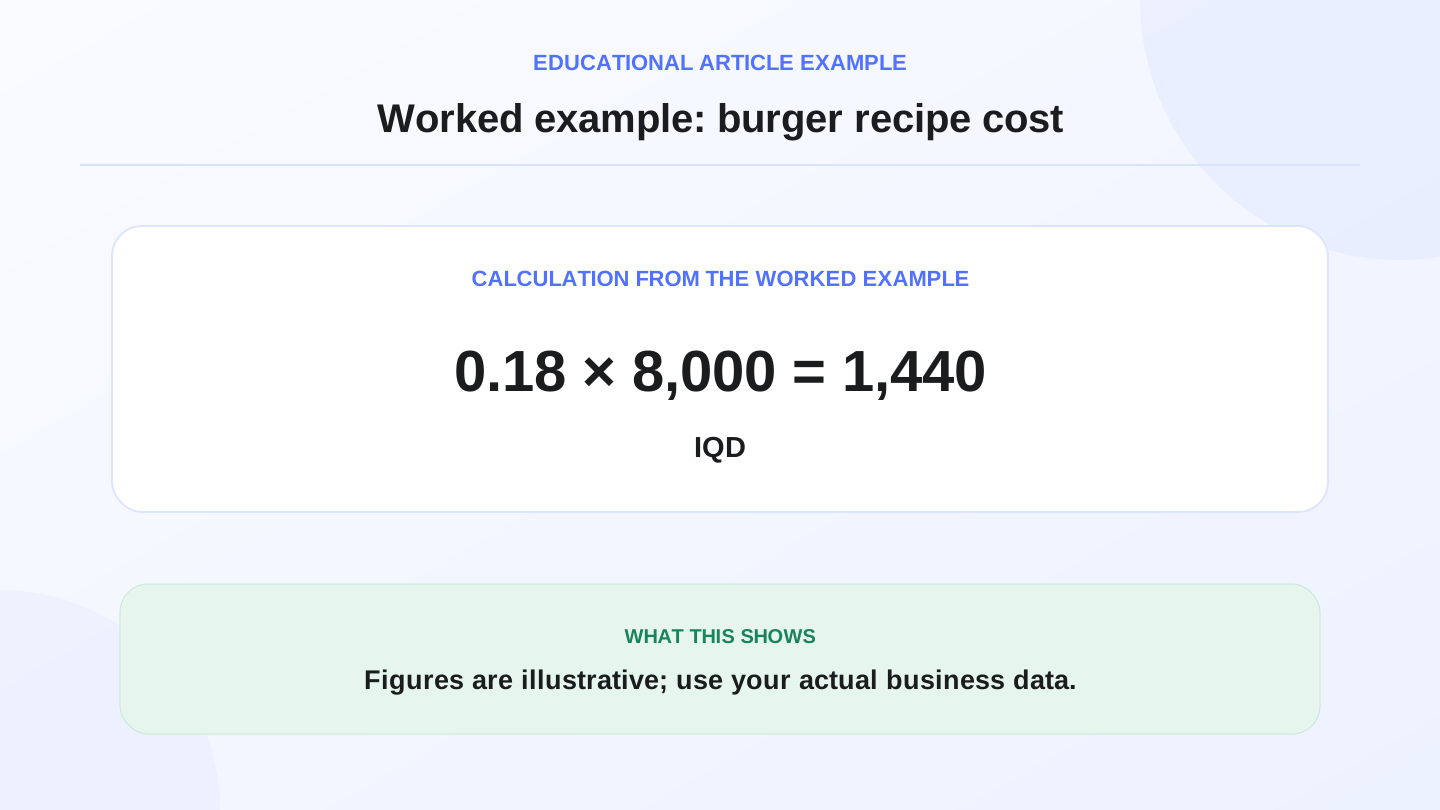
Assume one burger uses 0.18 kg beef at 8,000 IQD per kg, one bun at 300 IQD, cheese at 250 IQD, vegetables and sauce at 200 IQD, and packaging at 150 IQD.
Beef cost = 0.18 × 8,000 = 1,440 IQD. Total recipe cost = 1,440 + 300 + 250 + 200 + 150 = 2,340 IQD. If the burger sells for 6,000 IQD, gross margin before labor, rent, delivery, and other expenses is 6,000 - 2,340 = 3,660 IQD.
If beef price rises to 10,000 IQD per kg, beef cost becomes 0.18 × 10,000 = 1,800 IQD, and recipe cost becomes 2,700 IQD. The same selling price now leaves 3,300 IQD before other expenses. That change matters when hundreds of burgers are sold.
06
Connect recipe deduction to POS sales
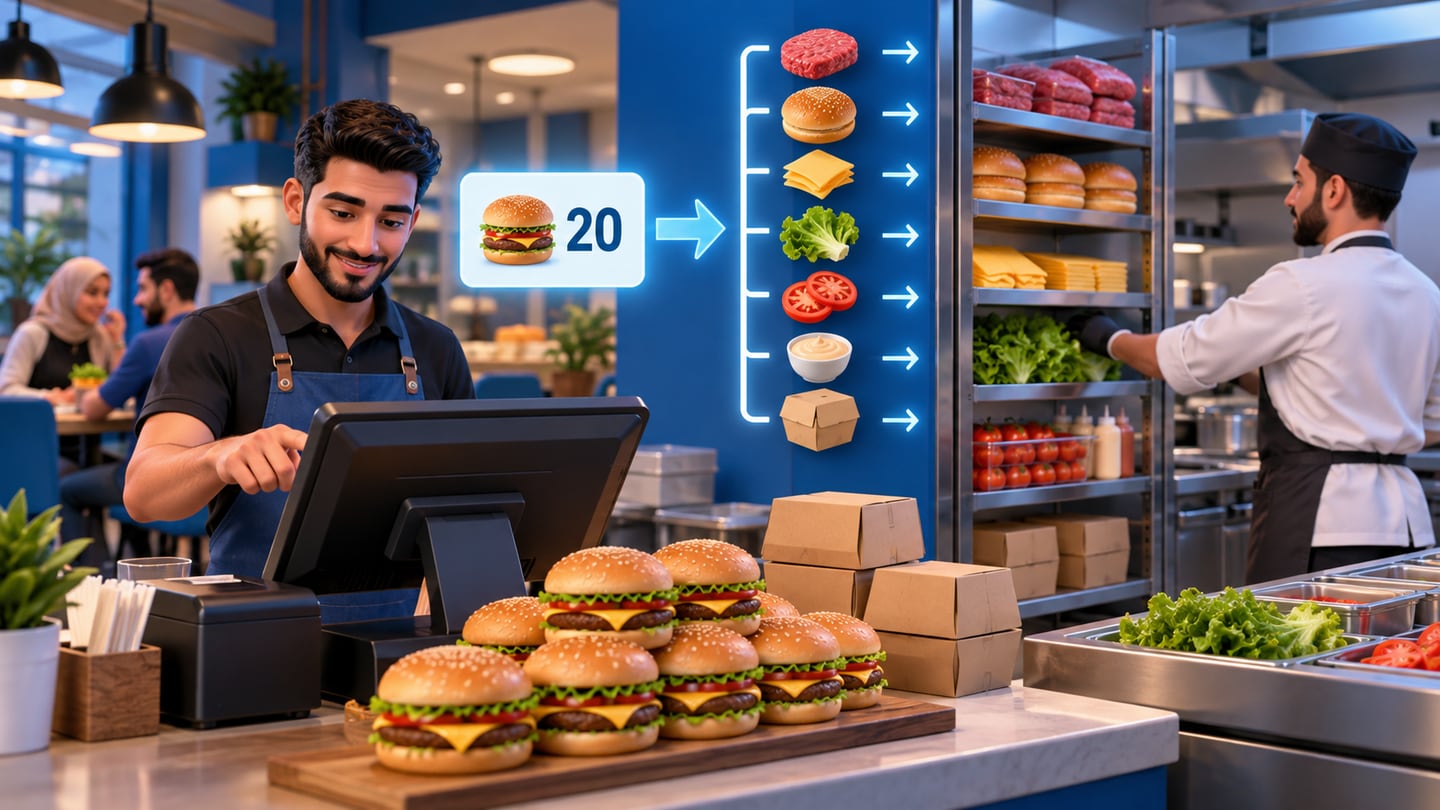
Recipe costing is strongest when connected to POS. When the cashier sells 20 burgers, the system should know that beef, buns, cheese, vegetables, sauce, and packaging were used according to the recipe. Otherwise the kitchen may count ingredients manually and reports will be late.
For cafes, bakeries, sweet shops, and production kitchens, this connection is even more important. Raw materials become finished goods, and finished goods are sold through POS or online orders. The owner needs to see both material usage and sales performance.
RA8M public materials describe Manufacture workflows for raw materials, recipes or formulas, finished goods, material usage, and cost calculation. Compare fit through RA8M industries, POS, and pricing.
07
Menu pricing and margin discipline
Recipe cost is not the full cost of a menu item. Rent, salaries, delivery fees, utilities, marketing, payment costs, waste, and discounts also matter. But recipe cost is the base. If the base is wrong, every other decision becomes weaker.
Restaurants should review high-volume items first. A tiny error on a best seller creates more damage than a large error on an item that sells once a week. Review supplier price changes regularly and update recipes when portion sizes change.
08
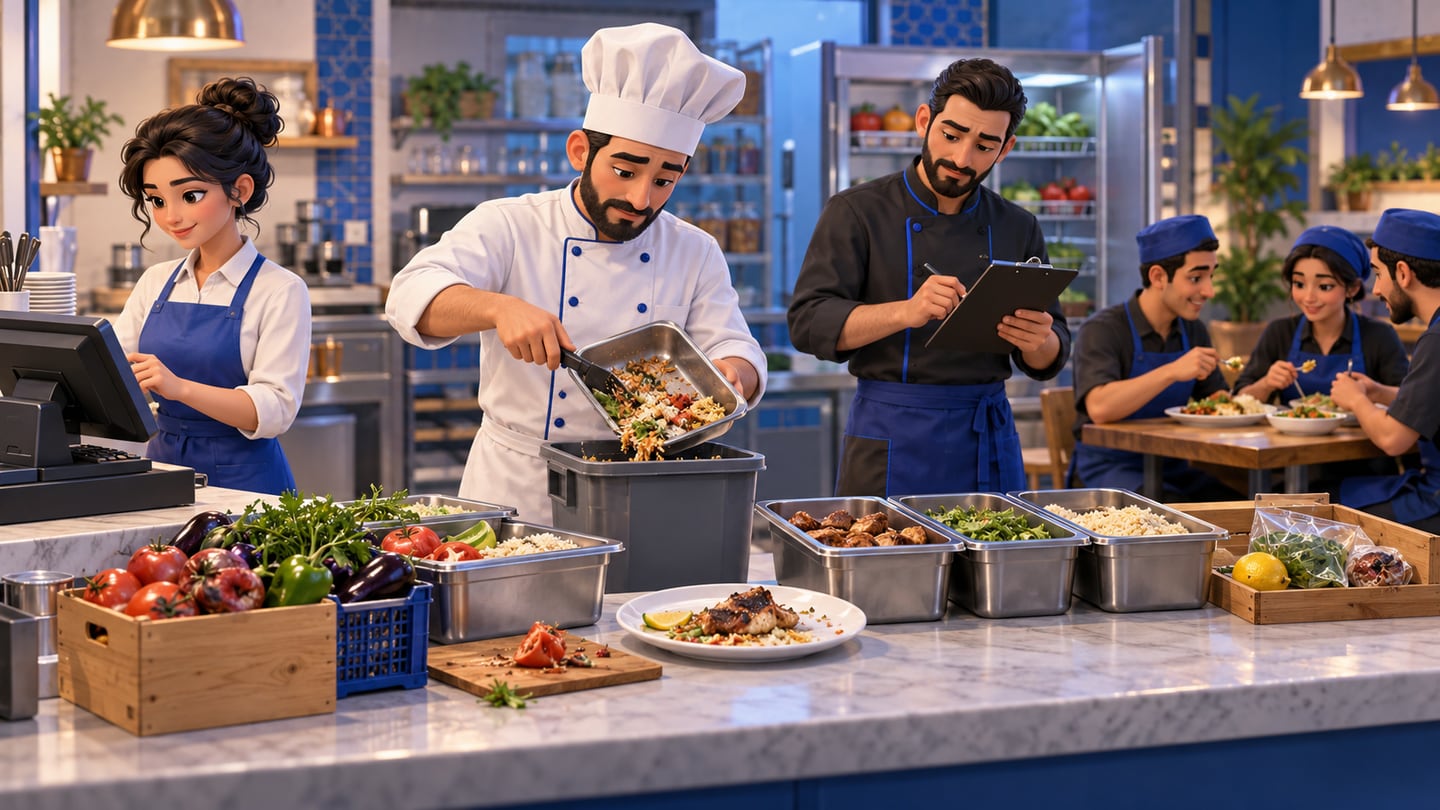
Waste, returns, and staff meals
Not every ingredient movement is a sale. Over-prep, mistakes, damage, expiry, returned orders, tasting, and staff meals can all consume materials. A good workflow records these separately so managers do not blame the POS sale for every stock difference.
This is where roles matter. Cashiers should sell. Kitchen leads may record waste. Managers approve adjustments. Owners review reports. Separating permissions protects the numbers.
09
Branches and consistency
If a restaurant has multiple branches, recipe consistency matters. One branch may use larger portions, record more waste, or buy from a different supplier. Branch-level reports help the owner see whether the same item has different cost behavior across locations.
Transfers also need care. If raw materials move from a warehouse to a branch, the movement should be recorded. Otherwise one location looks short and another looks overstocked.
10
When manual costing is enough
Manual recipe costing can work for a tiny menu with stable prices and one owner who prepares everything. A spreadsheet may be enough at the start if products are simple and sales volume is low.
Upgrade when supplier prices change often, the team grows, branches open, delivery packaging matters, recipes have many ingredients, or stock differences create arguments. At that point, connected recipe costing saves time and improves decisions.
11
Where RA8M fits
RA8M fits Iraq restaurants, cafes, bakeries, sweets shops, and production businesses that need POS, raw materials, recipes, finished goods, purchases, inventory, roles, branches, and reports in one Arabic-first platform. It is especially useful when cashier sales should keep working offline and sync later.
A simpler setup may be enough if you sell a small number of ready-made items with no ingredient tracking. If your menu depends on raw materials and portion control, recipe costing should be part of the system.
12
Conclusion
Restaurant recipe costing turns kitchen activity into business numbers. It helps owners understand food cost, menu margin, purchasing needs, waste, and branch consistency. The best setup connects recipes to POS sales and inventory, rather than leaving calculations in a forgotten spreadsheet.
Once ingredient cost per item is known, the break even point guide for Iraq cafés shows how to combine unit margin with monthly fixed bills to estimate the sales volume needed to cover them.
For Iraq operators, start with the items that sell most, calculate real ingredient cost, include packaging, connect purchases, and review reports weekly. RA8M is relevant when that workflow needs to sit beside POS, inventory, finance, branches, and ecommerce.
13
FAQs
What is restaurant recipe costing?
Restaurant recipe costing calculates the ingredient cost of one menu item by multiplying each ingredient quantity by its unit cost and adding packaging or preparation costs where relevant.
Why should recipe costing connect to POS?
A POS connection helps each sale deduct the right ingredients or finished goods, making food cost, inventory, and purchasing reports more reliable.
Does RA8M support recipes and raw materials?
RA8M public materials describe Manufacture workflows for raw materials, recipes or formulas, finished goods, material usage, and cost calculation.
When is manual recipe costing enough?
Manual costing can work for a tiny menu with stable supplier prices, but software becomes useful when items, ingredients, staff, branches, or purchase prices change often.
Frequently asked questions
What is restaurant recipe costing?
Restaurant recipe costing calculates the ingredient cost of one menu item by multiplying each ingredient quantity by its unit cost and adding packaging or preparation costs where relevant.
Why should recipe costing connect to POS?
A POS connection helps each sale deduct the right ingredients or finished goods, making food cost, inventory, and purchasing reports more reliable.
Does RA8M support recipes and raw materials?
RA8M public materials describe Manufacture workflows for raw materials, recipes or formulas, finished goods, material usage, and cost calculation.
When is manual recipe costing enough?
Manual costing can work for a tiny menu with stable supplier prices, but software becomes useful when items, ingredients, staff, branches, or purchase prices change often.
Written by
RA8M Team
Practical guides for restaurants, shops, and operations teams
Next step
Try RA8M with data close to your operation
Read next