Warehouse Barcode Inventory in Iraq: Receiving, Counts and Transfers
A warehouse-focused guide for Iraq businesses using barcode labels for receiving, bin control, cycle counts, transfers, and inventory variance checks.

Warehouse barcode inventory is a stock-control workflow where barcode labels are used before checkout: receiving goods, labeling bins, counting shelves, transferring stock between locations, and investigating variances. It is different from POS barcode scanning because the main goal is warehouse accuracy and movement control, not faster cashier checkout.
01
Warehouse Barcode Inventory in Iraq: Receiving, Counts and Transfers
Warehouse barcode inventory is not the same article as POS barcode checkout. The checkout article is about scanning products at the cashier. This guide is about what happens before the product reaches the cashier: receiving, labeling, bin control, cycle counts, branch transfers, and variance review.
Quick answer: Warehouse barcode inventory is a stock-control workflow where barcode labels are used before checkout: receiving goods, labeling bins, counting shelves, transferring stock between locations, and investigating variances. It is different from POS barcode scanning because the main goal is warehouse accuracy and movement control, not faster cashier checkout.
02
Why warehouse barcode inventory is a separate intent
A retail POS barcode workflow answers the question, "How do I scan products faster at checkout?" A warehouse barcode workflow answers a different question: "How do I know where stock is, what arrived, what moved, and why counted quantity does not match expected quantity?" That distinction matters for Iraq businesses with storage rooms, branches, wholesale orders, or frequent receiving.
A mini-market may scan at the cashier all day but still lose control in the store room. A clothing shop may sell variants correctly but mix sizes during receiving. A distributor may know total quantity but not which branch or shelf holds it. Warehouse barcode inventory focuses on these stock-control problems.
RA8M can connect this workflow with inventory and POS operations, industry use cases, and owner reporting so warehouse movement does not become a disconnected spreadsheet.
03
What should happen during receiving
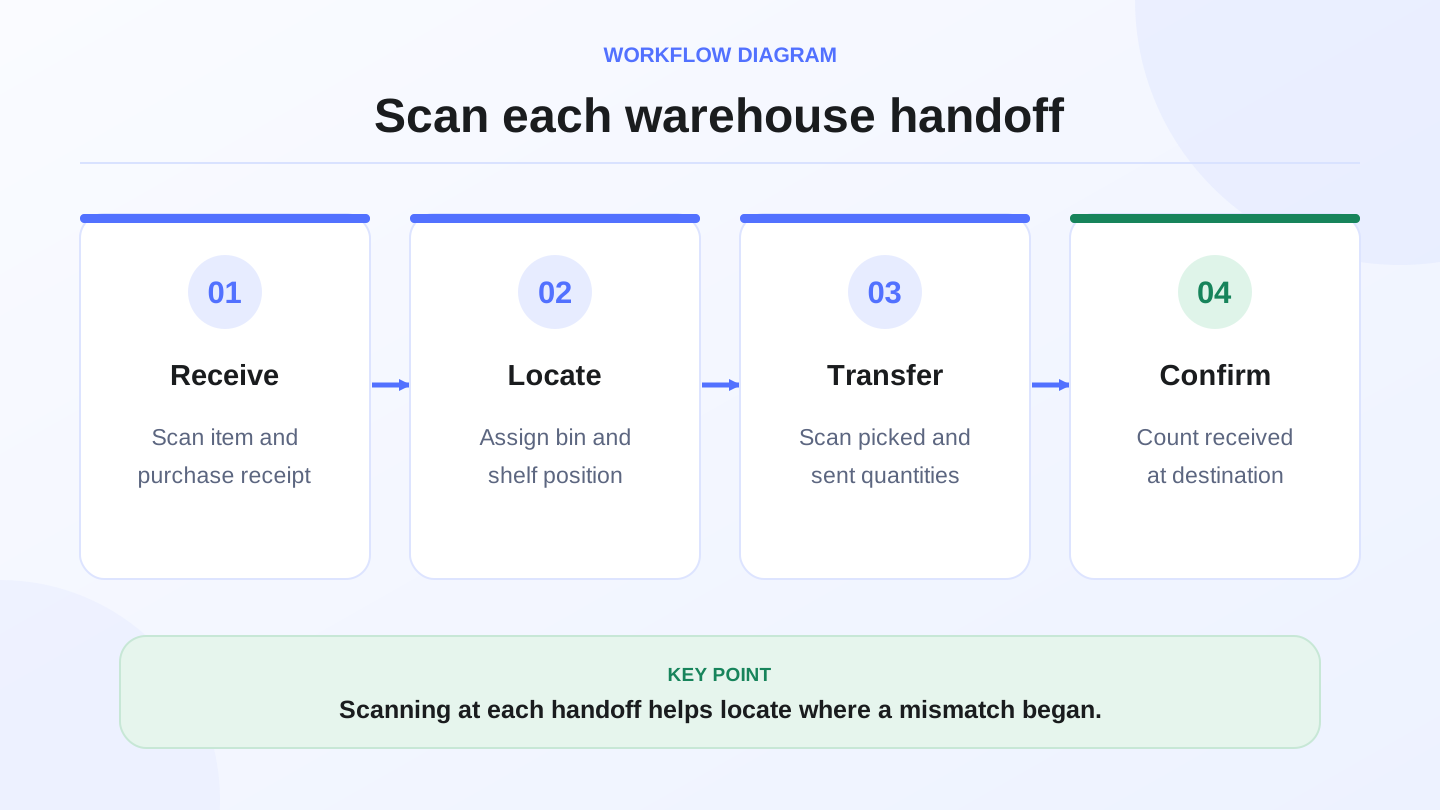
Receiving is where inventory accuracy begins. When goods arrive from a supplier, staff should verify the purchase, count actual received quantity, assign or confirm item labels, and record where the stock will be stored. If this step is weak, every later report becomes questionable.
A barcode process can help by making staff scan the item or label before adding quantity. The system should know whether the movement is a purchase receipt, manual adjustment, return, transfer, or count correction. The label alone is not enough; the movement type must also be clear.
04
Bin labels, item labels and location control
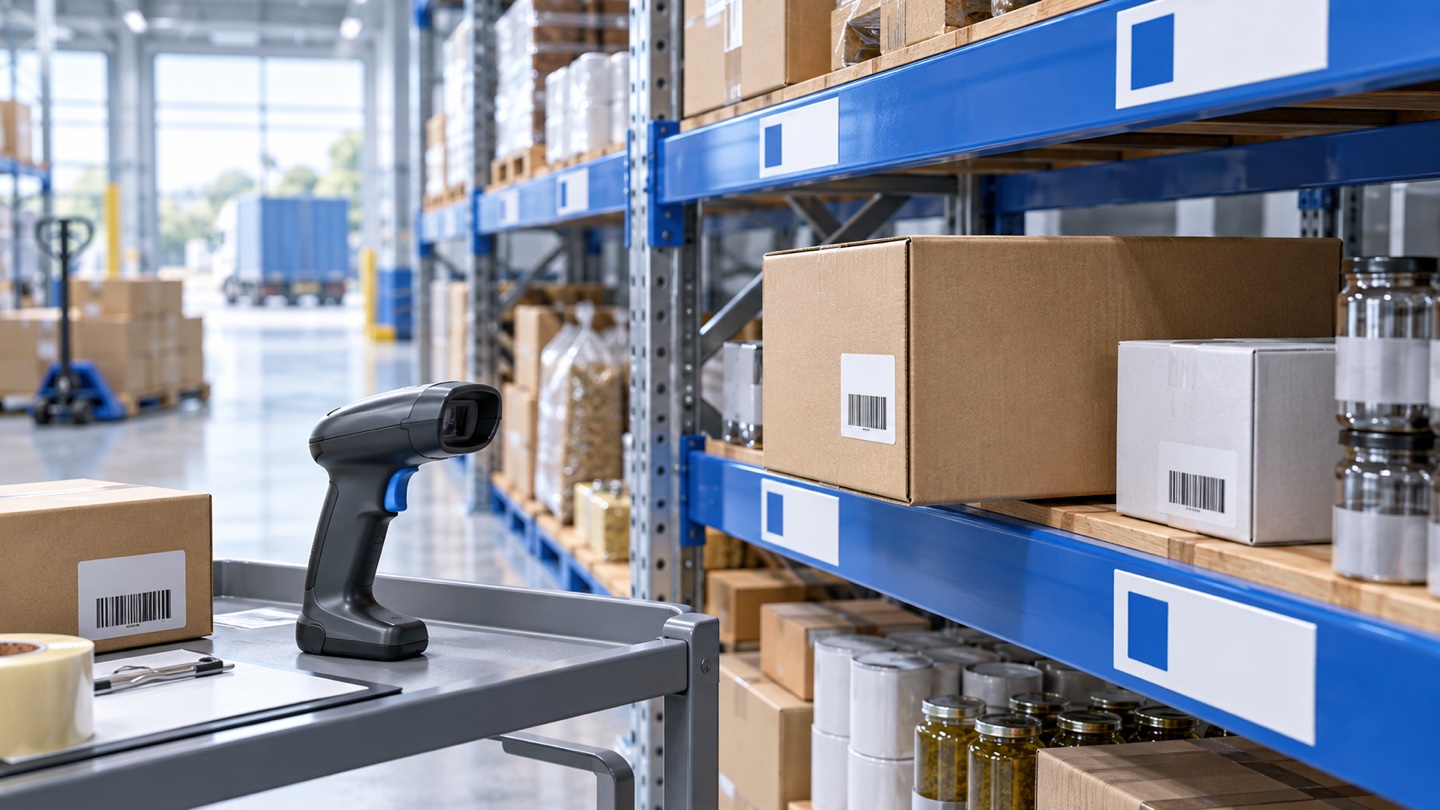
Warehouse labels can describe products, shelves, bins, or boxes. Product labels identify the SKU. Bin labels identify the storage location. Box labels can group a quantity for easier movement. The best choice depends on the business.
This is clearly different from checkout scanning. The cashier may never see a bin label, but the warehouse team depends on it.
| Label type | Used for | Example control question |
|---|---|---|
| Product label | Identifying each SKU or variant | Is this the correct item and size? |
| Bin label | Finding a shelf or storage area | Where should this product be stored? |
| Box label | Moving a packed quantity | How many units are inside this carton? |
| Transfer label | Moving stock between branches | Did branch A send and branch B receive? |
05
Worked example: branch transfer accuracy
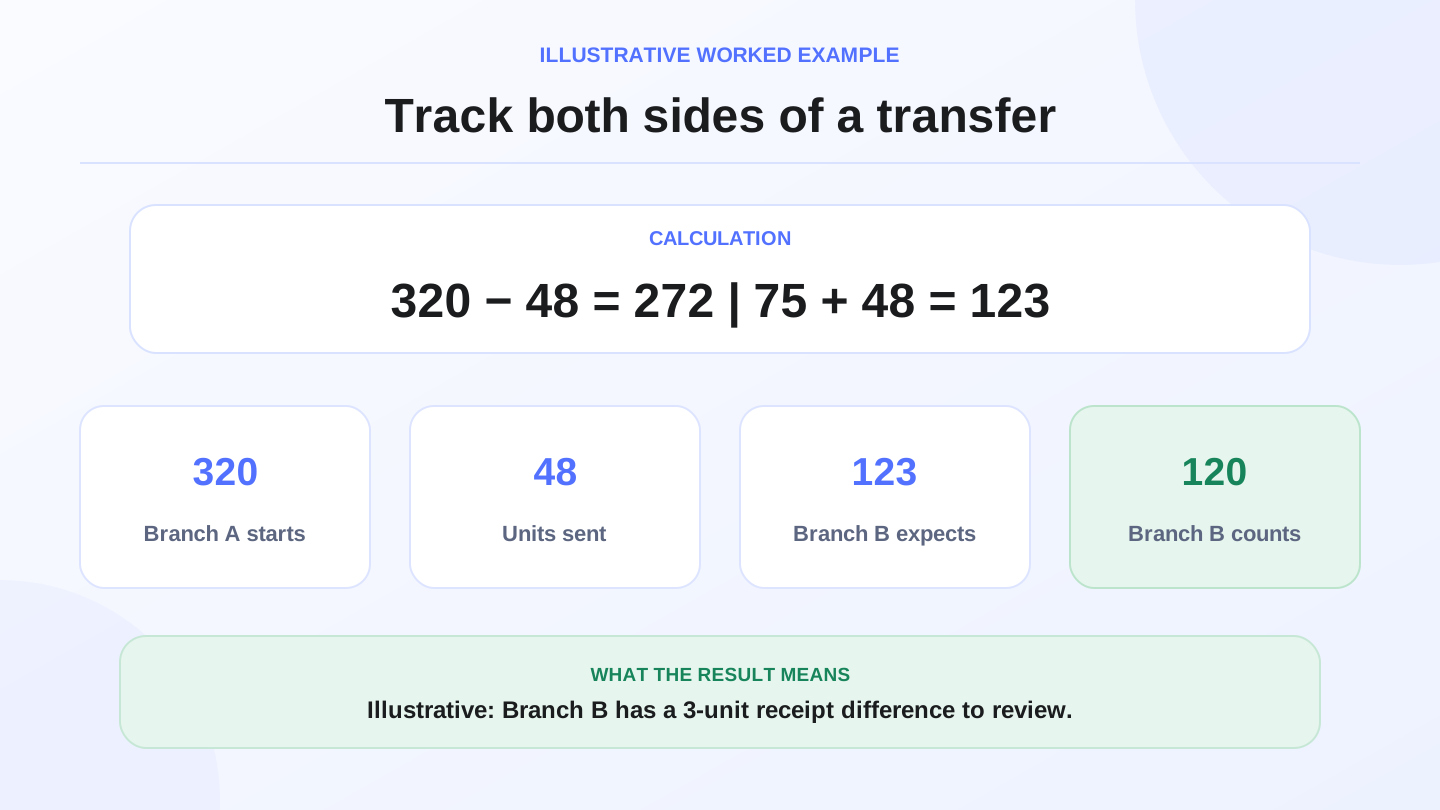
Imagine Branch A has 320 units of a product and Branch B has 75 units. The owner transfers 48 units from Branch A to Branch B.
Expected stock after the transfer is:
`Branch A: 320 - 48 = 272 units`
`Branch B: 75 + 48 = 123 units`
If Branch B counts only 120 units after receiving, the variance is:
`123 expected - 120 counted = 3 missing units`
A warehouse barcode workflow helps identify whether the issue happened during picking, packing, transport, receiving, or later shelf movement.
06
Cycle counts instead of one painful annual count
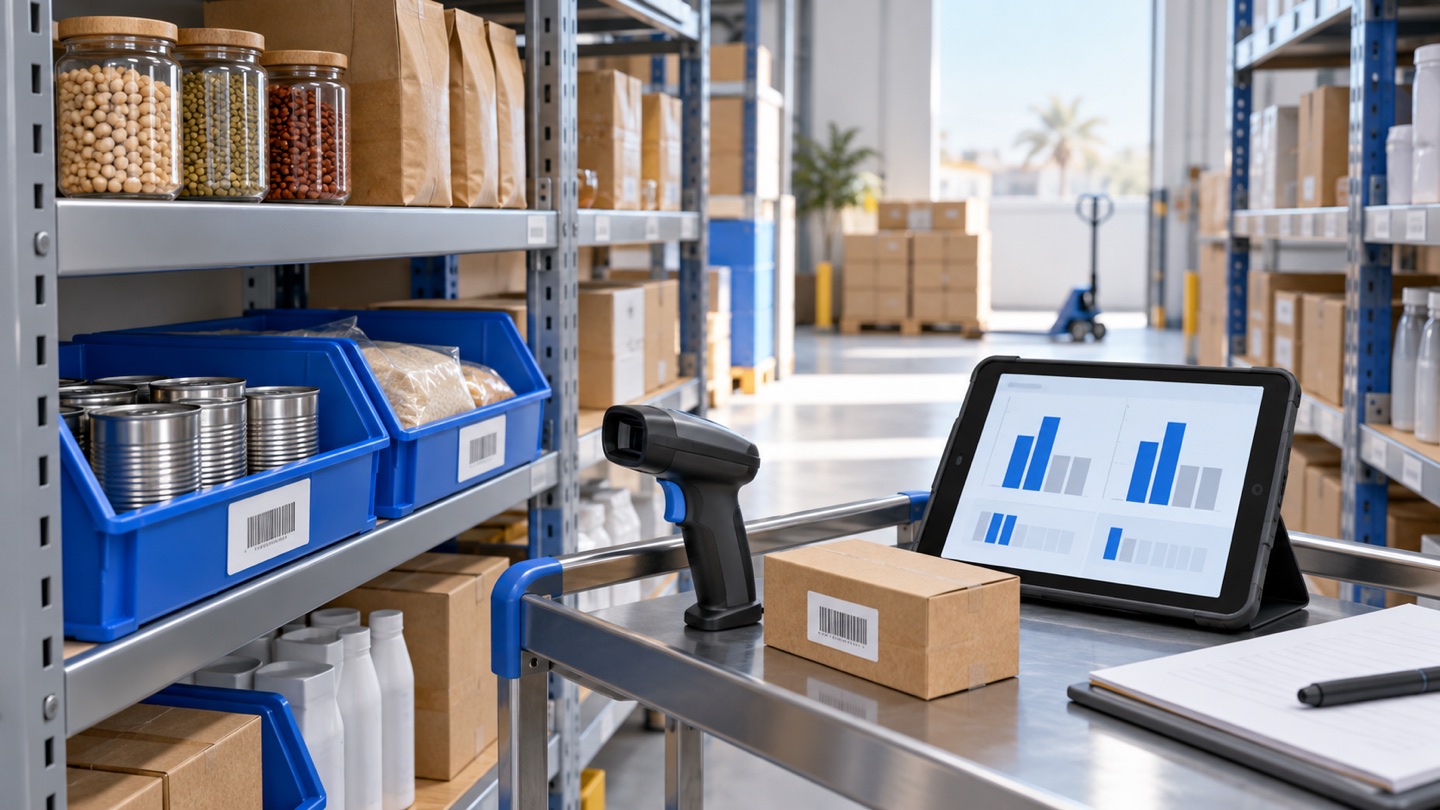
Many businesses delay stock counting because full inventory counts interrupt work. Cycle counting is easier: count a small group of items each day or week. Barcode labels make this faster because staff scan the location or product, count quantity, and record variance immediately.
For Iraq businesses with internet interruptions, the workflow should also tolerate offline-ready selling and later syncing where the product supports it. The goal is not perfect theory; the goal is a practical routine staff can follow consistently.
07
Roles and accountability
Warehouse barcode inventory needs permissions. Not every cashier should change warehouse quantity. Not every warehouse worker should edit product cost. Not every employee should approve a transfer. Staff roles protect the data.
A simple rule works well: one role receives stock, another reviews variances, and a manager approves unusual adjustments. The system should show who made each movement and when. Without accountability, barcode labels can still produce bad data.
08
Reports owners should review
The owner should not review every scan. They should review exceptions: high variance products, frequent adjustments, negative stock, late transfers, and items with high sales but low reorder discipline. These reports turn warehouse barcode inventory into management control.
Useful reports include received quantity by supplier, stock by branch, transfer status, adjustment reason, low-stock list, and variance by product. If reports are missing, barcode scanning becomes operational activity without management value.
09
When RA8M fits and when a simpler setup is enough
A very small shop with one shelf and a few products may not need warehouse barcode discipline yet. Manual product selection and simple counts can be enough. RA8M fits better when the business has storage rooms, many SKUs, variants, branches, ecommerce orders, purchases, or managers who need reliable daily reports.
Before choosing, review RA8M pricing because plans and add-ons may change. The business case should be based on fewer stock mistakes, faster counts, clearer transfers, and better owner visibility.
10
Implementation checklist
1. Clean product names and variants before printing labels.
2. Decide which items need product labels and which areas need bin labels.
3. Record receiving as a movement, not as a manual note.
4. Separate transfer sending and transfer receiving.
5. Count small groups frequently instead of waiting for a full shutdown.
6. Review variance reports weekly until the workflow stabilizes.
11
Common rollout mistakes
The first mistake is treating warehouse barcode work as a hardware purchase. A scanner cannot fix duplicate product names, unclear variants, or missing receiving rules. Clean the product list first, then decide how labels should be created and who can change them.
The second mistake is skipping location discipline. If staff scan the product but still place it anywhere, the system may know total quantity but not where the stock sits. For growing warehouses, location labels are often as important as product labels.
The third mistake is ignoring small variances. A difference of two or three units may look minor, but repeated weekly variance shows a process problem. Review small differences early before they become normal. Owners should also compare warehouse exceptions with sales reports: if the same items show high sales and repeated variance, the business may need better receiving checks, shelf placement, or staff permissions rather than more labels.
12
Conclusion
Warehouse barcode inventory in Iraq is about stock truth before checkout. It helps businesses receive accurately, store clearly, transfer between branches, count faster, and investigate variance. Keep it separate from POS barcode checkout: both matter, but they solve different problems.
Frequently asked questions
How is warehouse barcode inventory different from POS barcode scanning?
POS barcode scanning speeds checkout, while warehouse barcode inventory controls receiving, storage locations, cycle counts, transfers, and stock variance before products reach the cashier.
Which Iraq businesses need warehouse barcode inventory?
Businesses with back-room stock, multiple branches, frequent receiving, wholesale orders, or many similar SKUs need it more than a shop with only a small shelf.
Do barcode labels replace stock counts?
No. They make stock counts faster and cleaner, but the business still needs cycle counts, variance review, and staff rules.
How can RA8M support this workflow?
RA8M connects inventory, purchases, POS, reports, roles, branches, and ecommerce so warehouse movements can stay aligned with daily sales and owner reporting.
Written by
RA8M Team
Practical guides for restaurants, shops, and operations teams
Next step
Try RA8M with data close to your operation
Read next