Sales Reports in Iraq: How to Read POS and Cashier Numbers
A practical guide to sales reports in Iraq: daily sales, top items, inventory, branches, and a worked cashier reconciliation example.
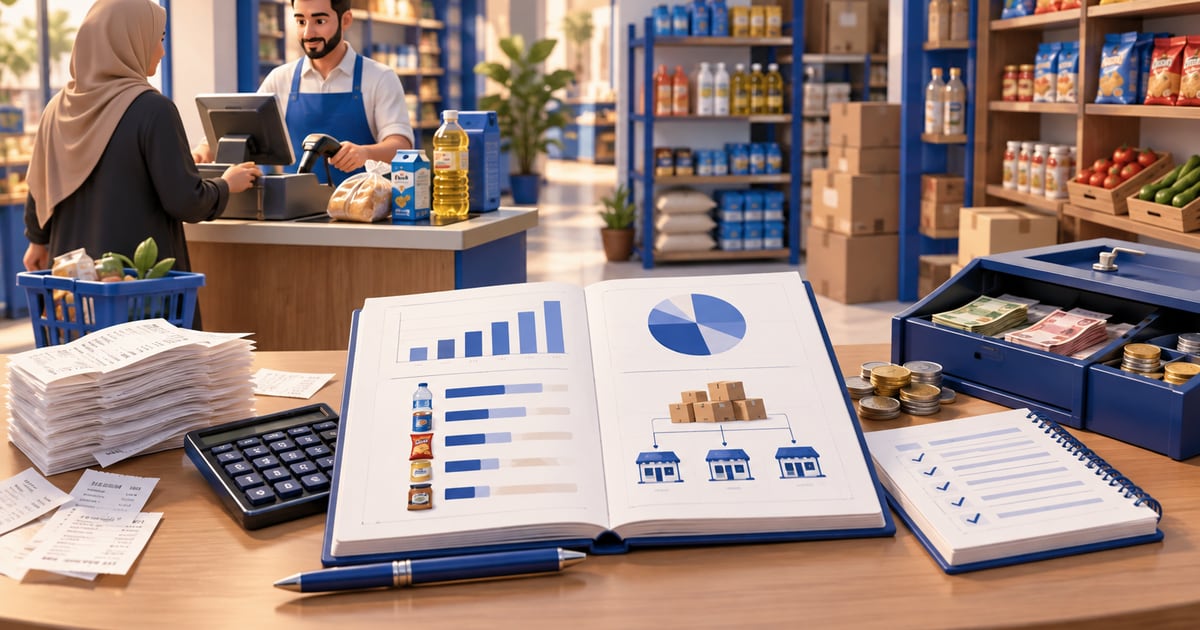
Sales reports are daily or weekly summaries that show how much a business sold, which items moved, expected cash in the drawer, and how inventory changed. In Iraq, a useful sales report should connect POS, inventory, accounting, and branches so owners can separate real sales from discounts, returns, and collected payments.
01
Sales Reports in Iraq: How to Read POS and Cashier Numbers
Sales reports are not only a page of numbers for the owner. They are a daily operating tool for checking whether cash, inventory, and branches are moving correctly. When the report connects sales to stock and finance, the owner can decide what to reorder, which item to stop, and which branch needs follow-up.
Quick answer: Sales reports are daily or weekly summaries that show how much a business sold, which items moved, expected cash in the drawer, and how inventory changed. In Iraq, a useful sales report should connect POS, inventory, accounting, and branches so owners can separate real sales from discounts, returns, and collected payments.
02
Why total sales alone is not enough
Many shop owners look at the total sales number at the end of the day and treat it as the whole story. It is not. A good total may come from heavy discounts, one fast-moving item, or a busy branch while the rest of the stock is slow. Cash in the drawer may also be lower than expected because of a return, shift mistake, or unpaid invoice.
A useful POS report answers operational questions: what was sold, who closed the sale, how the customer paid, whether inventory moved, and whether discounts or returns were unusually high. When these answers live in one system, the team depends less on WhatsApp notes or manual spreadsheets.
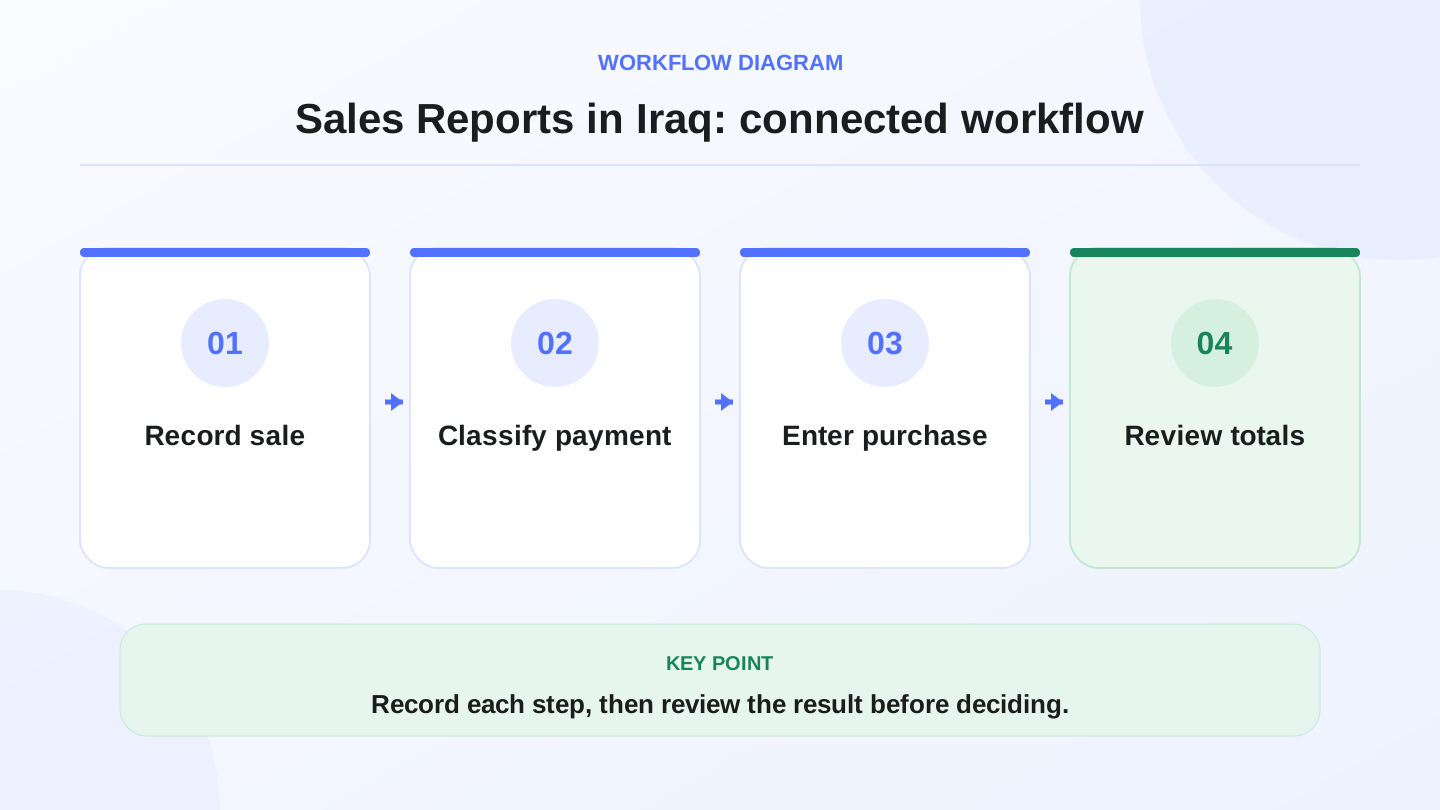
A practical sequence has four connected steps: Record sale, Classify payment, Enter purchase, Review totals. Recording each step makes the daily result easier to review.
03
Which reports does an Iraq shop or restaurant need?
Not every business needs the same dashboard. A restaurant watches meals, modifiers, and ingredients. A clothing shop watches sizes, colors, and seasonal movement. A supermarket watches barcodes, quantity, and low stock. Still, most businesses share a basic reporting spine.
| Business type | Most important report | Why it matters |
|---|---|---|
| Restaurant or cafe | Item and meal sales | Shows fast dishes and raw material pressure |
| Clothing shop | Sales by size or color | Reduces missing sizes and improves purchasing |
| Supermarket | Low-stock item report | Prevents lost sales from empty shelves |
| Pharmacy | Item movement and balance | Supports disciplined sales and stock control |
| Multi-branch business | Branch and consolidated reports | Shows strongest and weakest locations |
04
How to read the daily sales report
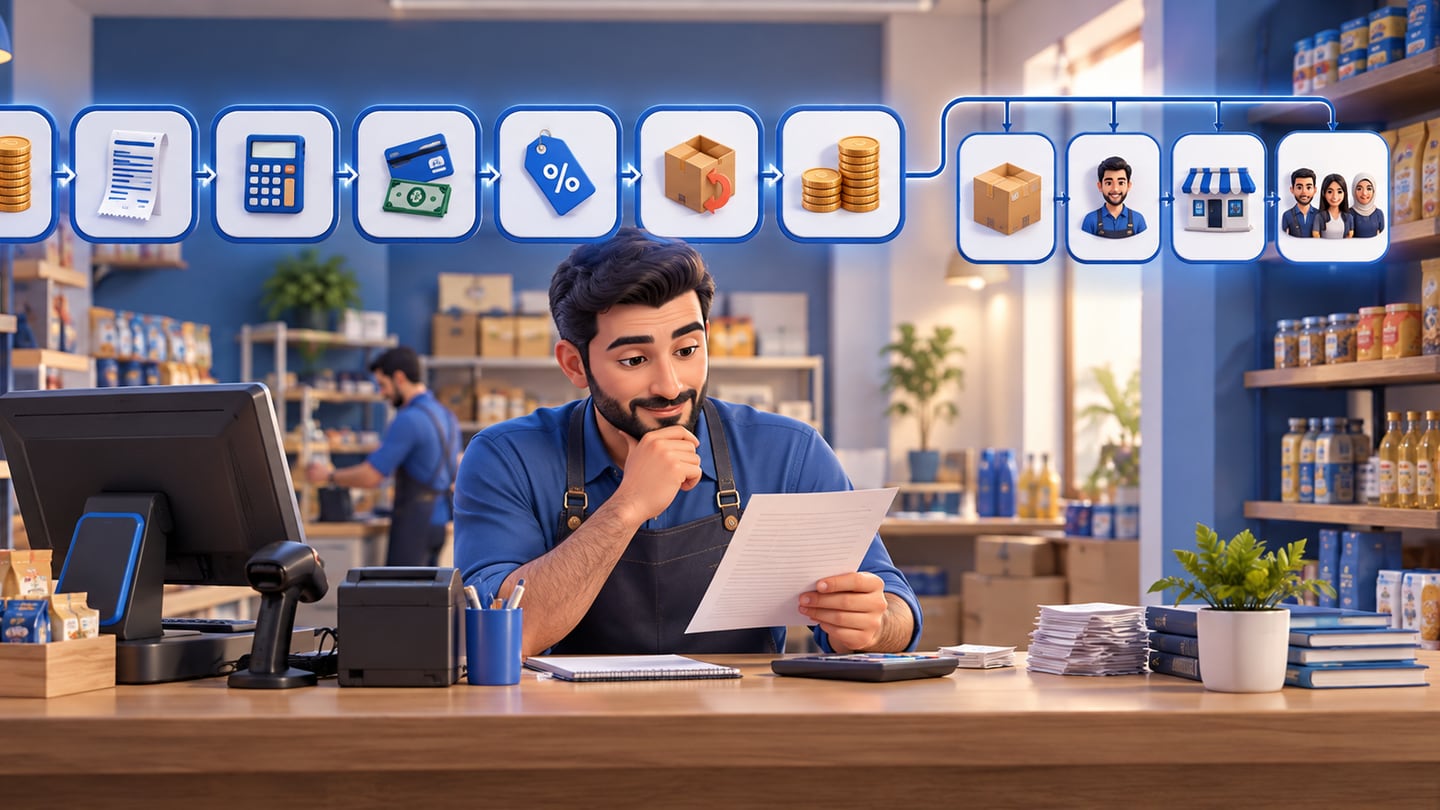
Start at the top: gross sales, number of invoices, average ticket, payment methods, discounts, returns, and net sales. Then move into detail: items, staff, branches, and customers if your workflow records customers.
The order matters. If you jump to item performance before reconciling cash, you may miss a shift-closing issue. If you only count cash, you may miss an item that sells well but has weak margin or consumes stock too quickly.
05
Worked example: cashier reconciliation at shift close
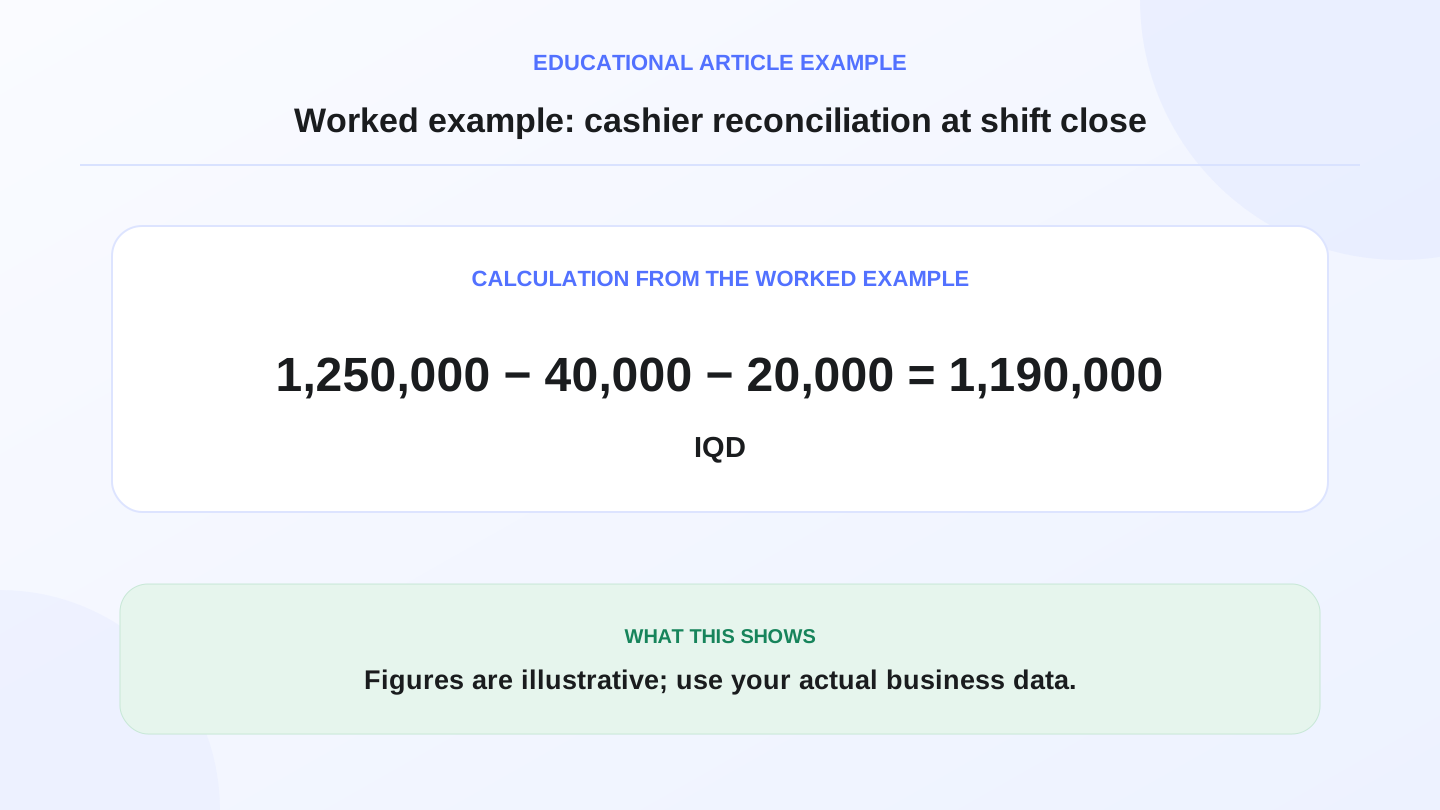
Assume a Baghdad shop records 1,250,000 IQD in gross sales in one day. The report shows 800,000 IQD in cash, 350,000 IQD by electronic payment, and 100,000 IQD unpaid or collected later. It also shows 40,000 IQD in returns and 20,000 IQD in discounts.
Net sales = 1,250,000 − 40,000 − 20,000 = 1,190,000 IQD. Expected cash in the drawer is 800,000 IQD if returns and discounts are already reflected in the report. If the physical cash count is 785,000 IQD, the difference is 15,000 IQD. The manager should check cash invoices, drawer openings, and staff notes before closing the day.
This example is illustrative, not a fixed accounting rule. The point is to use the report to ask the right question quickly instead of reviewing every invoice manually.
06
How sales reports connect to inventory
A sales report becomes more valuable when stock updates automatically. If you sell 30 units of an item, the inventory balance should change. If you use raw materials or recipes, such as a cafe using coffee and milk, the connected materials should be deducted where the workflow supports it.
The problem with separate tools is that the cashier says one thing while inventory says another. After two weeks, the gap becomes large and hard to explain. Connecting sales and stock helps owners catch theft, spoilage, wrong entry, or over-ordering from suppliers.
07
Branch reporting: when does it matter?
If you operate two or more branches, the company-wide number is not enough. You need to know which branch sold more, which branch uses more discounts, and which branch is under stock pressure. The consolidated report helps the owner; the branch report helps the local manager act.
In Iraq, sales behavior can differ by Baghdad, Basra, Erbil, or even by neighborhood. Do not treat every branch as the same. A good report compares sales, invoice count, average ticket, staff activity, and stock balance fairly.

08
What if the report is hard to understand?
If every report needs a long explanation from staff, the reporting setup is weak. A good report should be readable in Arabic or English, with clear numbers and logical grouping. This does not mean every small business needs a complex dashboard. Often a simple daily report plus deeper detail on demand is enough.
Use a five-minute test: can you read the report and understand what happened today? If not, the issue may be report design, item naming, payment setup, or the way employees enter data at the POS.
09
Where RA8M fits, and when a simpler setup is enough
RA8M fits businesses that want POS, inventory, purchases, customers, finance, reports, roles, and branches connected in one system. This is useful for restaurants, cafes, retail shops, supermarkets, pharmacies, and operators that do not want the cashier isolated from daily management.
If your business is very small, sells only a few items, and does not need inventory or branch reporting, a notebook or spreadsheet may be enough for a short time. But once you add staff, discounts, purchases, moving stock, or multiple locations, a connected POS becomes safer.
10
Useful internal links
11
Checklist before trusting your sales reports
Test reports on a small set of real data before training the full team. Create 20 items, two employees, two payment methods, and two branches if relevant. Run a trial day, then read the results.
| Question | Pass mark |
|---|---|
| Does it show net sales after discounts and returns? | Yes, clearly |
| Does expected cash match payment methods? | Yes, with a shift log |
| Does stock change after sales? | Yes, for linked items |
| Can you filter by branch or employee? | Yes, where needed |
| Is the report readable in Arabic or English? | Yes, without long explanation |
12
Conclusion
When customer identities can be matched responsibly across completed orders, a sales report can also support a separate customer retention review. Keep repeat buyers distinct from the number of invoices, and show how much of the order history can actually be linked to a person.
Good sales reports do more than show a nice number. They create a management rhythm. Review daily sales, reconcile cash, understand item movement, connect inventory, and compare branches. When this becomes a daily habit, surprises drop and decisions become faster.
RA8M helps Iraq businesses connect cashier sales with inventory and reporting in one system. Treat reports as an operating tool, not just an end-of-day screen.
13
FAQs
Which report should I check every day?
Start with the daily sales report because it brings together total sales, payment methods, discounts, returns, and expected cash. Then review top-selling items and low-stock products.
Do sales reports replace an accountant?
No. Reports organize operational data and reduce manual work, but they do not replace an accountant or qualified professional for tax, legal, or formal financial decisions.
How do I know a cashier report is correct?
Match total sales to payment methods, then compare expected cash with the physical cash counted. Also review returns, discounts, and shift-closing logs.
Do branches need separate reports?
Yes. A branch-level report plus a consolidated report helps you see where sales, shortages, and stock pressure are happening.
Where does RA8M help with reports?
RA8M connects POS with inventory, customers, purchases, finance, and roles, helping Iraq owners read operations from one system instead of scattered files.
Frequently asked questions
Which report should I check every day?
Start with the daily sales report because it brings together total sales, payment methods, discounts, returns, and expected cash. Then review top-selling items and low-stock products.
Do sales reports replace an accountant?
No. Reports organize operational data and reduce manual work, but they do not replace an accountant or qualified professional for tax, legal, or formal financial decisions.
How do I know a cashier report is correct?
Match total sales to payment methods, then compare expected cash with the physical cash counted. Also review returns, discounts, and shift-closing logs.
Do branches need separate reports?
Yes. A branch-level report plus a consolidated report helps you see where sales, shortages, and stock pressure are happening.
Where does RA8M help with reports?
RA8M connects POS with inventory, customers, purchases, finance, and roles, helping Iraq owners read operations from one system instead of scattered files.
Written by
RA8M Team
Practical guides for restaurants, shops, and operations teams
Next step
Try RA8M with data close to your operation
Read next