Purchase Management Software in Iraq: Stock, Bills and Reports
A practical guide to purchase management software in Iraq covering supplier bills, received quantities, stock increases, costs, payment tracking, and POS reports.

Purchase management software helps Iraq businesses record supplier bills, received quantities, purchase costs, vendor payments, remaining balances, and stock increases in one controlled workflow. The best setup connects purchases with POS inventory, finance, and reports so owners can compare what they bought, what they sold, what remains in stock, and what they still owe suppliers.
01
Purchase Management Software in Iraq: Stock, Bills and Reports
Purchase management software helps a business control what it buys before those goods become sales. For shops, restaurants, supermarkets, pharmacies, salons, and small manufacturers in Iraq, purchasing should not live in scattered WhatsApp messages, notebooks, and disconnected spreadsheets.
Quick answer: Purchase management software helps Iraq businesses record supplier bills, received quantities, purchase costs, vendor payments, remaining balances, and stock increases in one controlled workflow. The best setup connects purchases with POS inventory, finance, and reports so owners can compare what they bought, what they sold, what remains in stock, and what they still owe suppliers.
02
What should purchase management software do?
Purchase management software should capture the buying workflow from supplier to stock. At minimum, it should record the vendor, bill date, item names, quantities, unit costs, total cost, payment status, remaining balance, and whether the purchased items increased stock.
The goal is not only accounting neatness. The goal is operational control. If a supermarket buys 200 cartons of juice, a retail shop buys 40 jackets, or a café buys 25 kg of coffee beans, the owner should later know where that stock went: sold through the cashier, transferred to another branch, adjusted because of damage, used in recipes, or still available.
03
Why purchases are an operations problem, not only an accounting task
Many businesses treat purchases as something the accountant records later. That creates a gap. The cashier may sell products today, the warehouse may receive goods today, but the financial record may be updated days later. During that gap, stock numbers can be wrong and owners may reorder too early or too late.
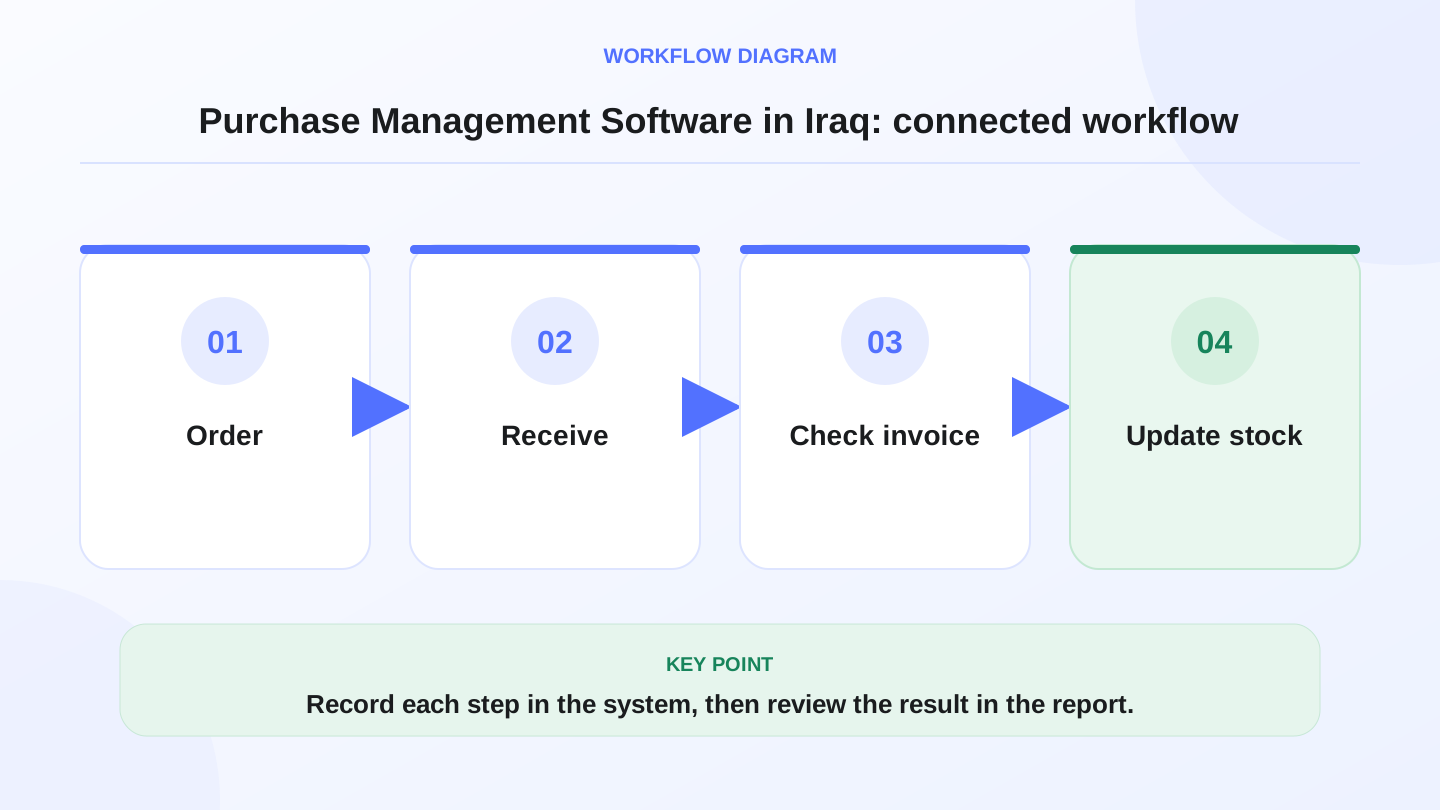
A better workflow connects purchase entry with inventory immediately. When goods are received, stock increases. When the POS sells those goods, stock decreases. When the supplier is paid, the vendor balance changes. This is how a purchase system supports accounting, inventory, and daily management at the same time.
04
Purchase workflow checklist for Iraq businesses
Use this checklist during a demo. Ask the software vendor to enter a real purchase, receive part of it, sell some stock, then show the supplier balance and inventory report.
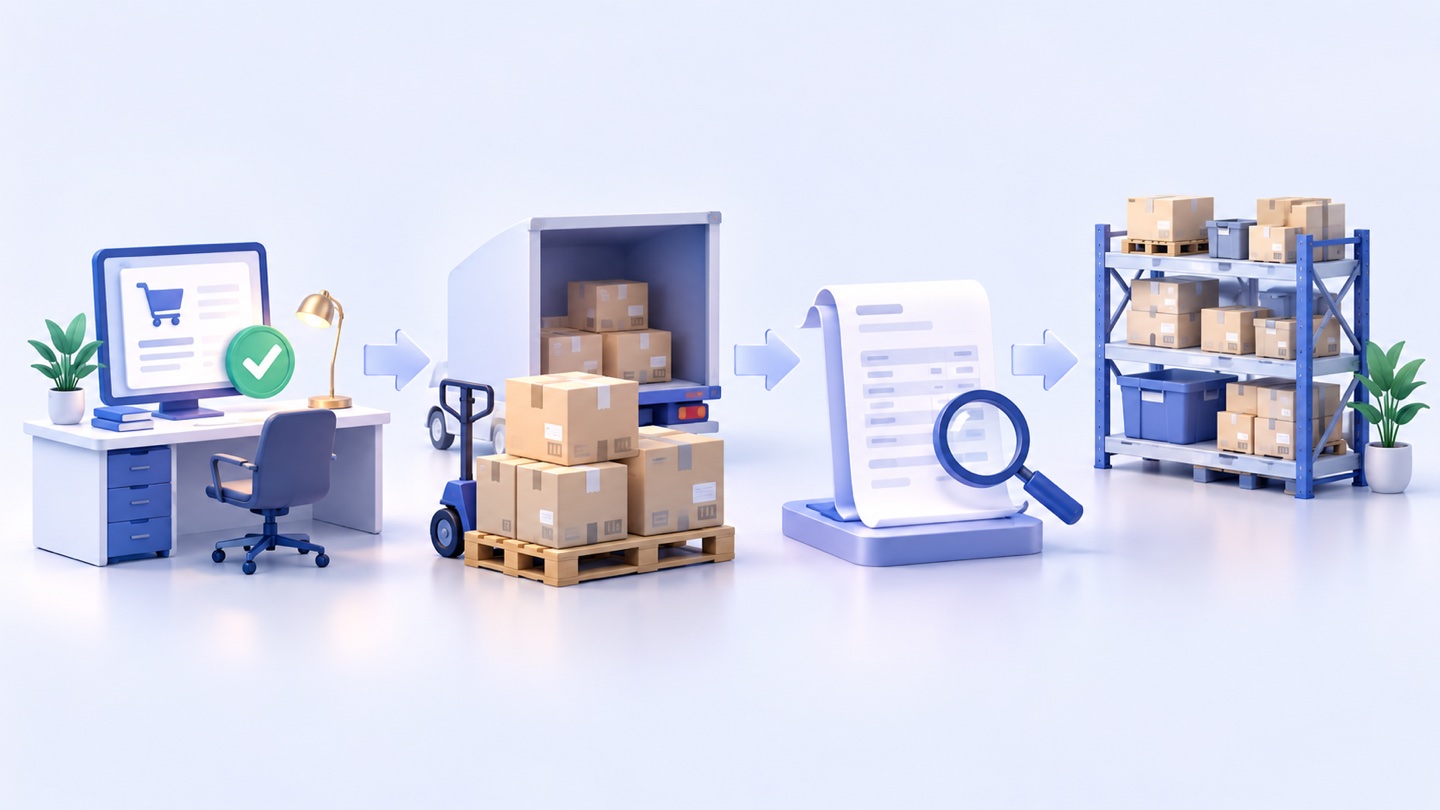
| Step | What to record | Why it matters |
|---|---|---|
| Supplier selection | Vendor name, phone, address, terms | Helps track who supplied each item and what is still owed |
| Purchase bill | Bill number, date, items, quantities, unit cost | Creates the source record for stock and cost |
| Receiving | Accepted quantity, damaged items, missing items | Prevents paying for goods that did not arrive correctly |
| Stock update | Product, warehouse or branch, quantity added | Keeps POS inventory close to reality |
| Payment | Cash, bank, partial payment, remaining balance | Shows supplier obligations clearly |
| Reports | Purchases by supplier, item, branch, and period | Helps owners compare buying with sales and stock |
05
Worked example: buying stock and calculating expected quantity
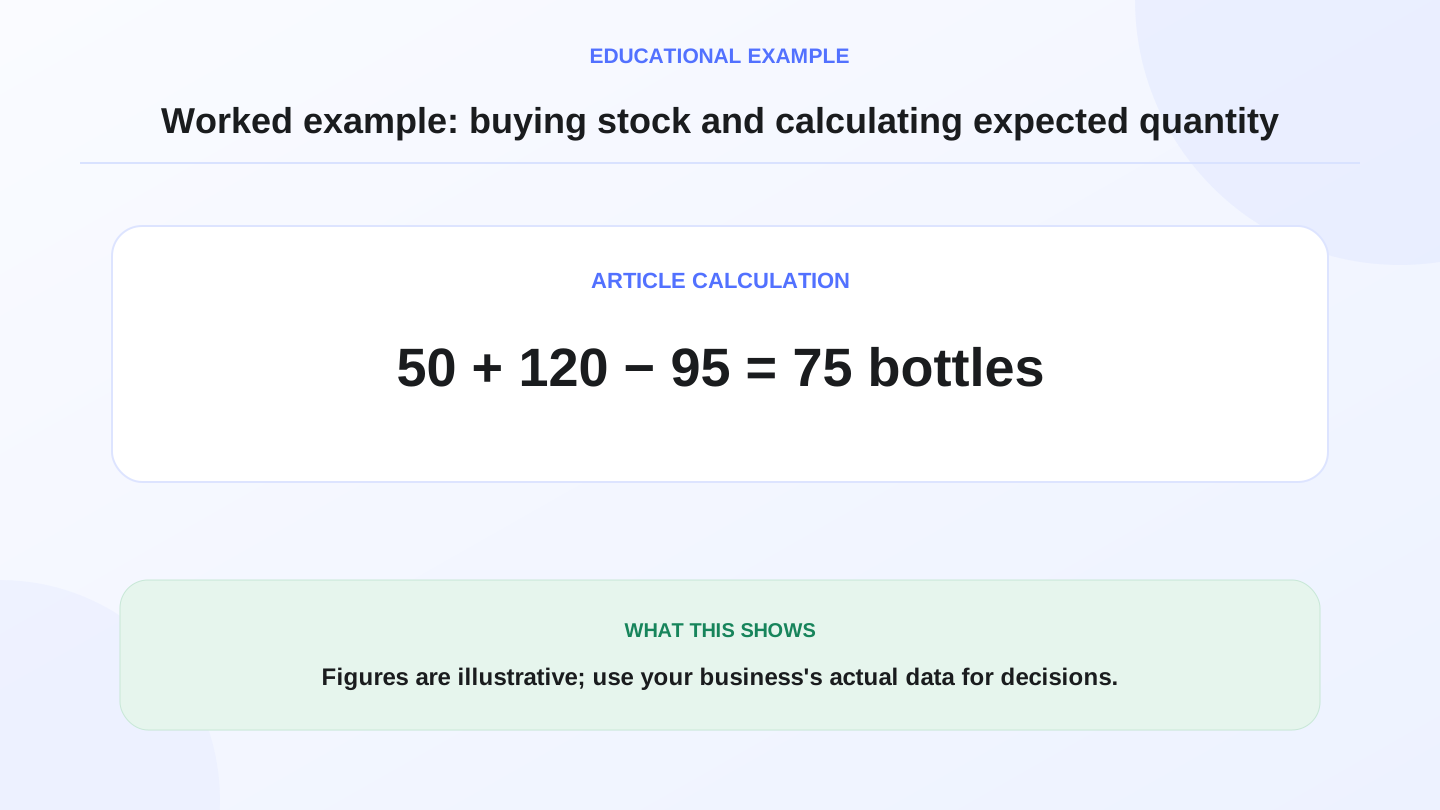
Assume a mini-market starts the morning with 50 bottles of water. The owner buys 120 more bottles from a supplier and enters the purchase bill in the system. During the day, the cashier sells 95 bottles.
Expected closing stock is: opening stock 50 + purchased stock 120 - sold stock 95 = 75 bottles.
If the physical count is 71 bottles, the variance is 71 - 75 = -4 bottles. The owner now has a clear investigation path: check unrecorded damage, wrong barcode sale, staff use, supplier short delivery, or cashier mistakes. Without connected purchases and POS inventory, this variance may stay hidden until the shelf is empty.
06
Supplier bills and partial payments
In Iraq, many businesses buy some goods in cash and some on supplier credit. A purchase management system should allow the team to record whether a bill is fully paid, partly paid, or still open. This matters for cash planning because profit on the shelf is not the same as cash in hand.
For example, a shop might buy 1,000,000 IQD of stock and pay 600,000 IQD today, leaving 400,000 IQD due later. The owner should be able to see that balance without searching paper bills. Cost examples in articles are illustrative; real supplier terms, tax treatment, and accounting decisions should be checked with a qualified professional when needed.

07
Inventory cost control starts at purchase entry
Inventory accuracy depends on the quality of purchase entry. If the purchase cost is wrong, margin reports become misleading. If the quantity is wrong, low-stock alerts become unreliable. If the product is entered under a duplicate name, sales reports and stock value both become messy.
Good purchase management should encourage product discipline: one product record, one barcode where possible, clear unit names, clean categories, and consistent costs. This is especially important for retail shops with variants, supermarkets with many SKUs, and production businesses that convert raw materials into finished goods.
08
Branches, warehouses, and received locations
A growing business may receive goods into one warehouse, then distribute them to branches. Purchase software should identify where stock entered the business. If every purchase goes into a generic location, branch-level stock becomes difficult to trust.
For a Baghdad branch and an Erbil branch, the owner may need separate stock visibility and consolidated reports. Purchases, transfers, adjustments, and sales should all point to the correct location. RA8M supports branches, roles, inventory, purchases, finance, reports, and POS workflows, which makes this type of control easier to compare in one system.
09
Reports owners should read weekly
Purchase reports should answer practical questions. Which suppliers did we buy from this month? Which items consumed the most cash? Which branch received the most stock? Did purchases increase while sales stayed flat? Are supplier balances growing faster than cash collections?
These questions matter because buying mistakes lock money into shelves. A report that shows purchases by supplier, item, category, branch, and date can help an owner negotiate better, reduce dead stock, and avoid emergency buying. Connect those reports with POS sales for a fuller picture.
10
When a simple spreadsheet may be enough
A simple spreadsheet can work for a very small business with few suppliers, few products, and an owner who personally handles every purchase. If the owner can remember what was bought, what was paid, and what remains in stock, full software may not be urgent.
Software becomes more useful when the business has multiple staff members, many products, supplier credit, branches, frequent stockouts, or unclear margins. The decision should follow operational pain. Do not buy complexity for its own sake; buy control when manual tracking starts creating costly mistakes.
11
Where RA8M fits
RA8M fits Iraq businesses that want purchase management connected to POS, inventory, finance, reports, customers, roles, branches, and ecommerce. Instead of treating supplier bills as isolated records, RA8M can help owners connect what they buy with what cashiers sell and what managers review.
If purchasing is already clean and simple, a lighter setup may be enough. If supplier bills, inventory value, branch stock, and payment balances need one Arabic-first workflow, review RA8M POS, RA8M pricing, and the broader RA8M industry use cases. Pricing can change, so verify current plans before buying.
12
Conclusion
Purchase management software is about discipline before the sale. It helps a business record supplier bills correctly, receive quantities accurately, update inventory on time, track payments, and read reports that explain where money and stock are going.
For Iraq businesses, the strongest purchase workflow is connected: suppliers, purchases, POS sales, inventory, finance, branches, and reports should support each other. Start by fixing the buying process, then let the cashier and reports confirm whether the stock is moving profitably.
Frequently asked questions
What is purchase management software?
Purchase management software records supplier bills, item quantities, purchase costs, payments, remaining balances, and stock increases so buying activity is connected to inventory and reports.
Why should purchases connect to POS inventory?
Purchases should connect to POS inventory because stock should increase when goods are received and decrease when products are sold, reducing manual updates and stock mistakes.
Does every small shop need purchase management?
A very small owner-operated shop may start with simple purchase notes, but purchase management becomes important when supplier bills, credit balances, product costs, or stock variances become hard to track manually.
Can RA8M support purchase and vendor workflows?
Yes. RA8M supports vendor management, purchase bills, bill items, payments, stock increases, finance, reports, and POS inventory workflows for Iraq businesses.
Written by
RA8M Team
Practical guides for restaurants, shops, and operations teams
Next step
Try RA8M with data close to your operation
Read next
Related RA8M guides
Accounting and Invoicing
Sales and Purchase Management Software in Iraq
Read article
Accounting and Invoicing
Arabic Accounting Software in Iraq: Practical Buyer Guide
Read article
Accounting and Invoicing
Accounting Software for Small Business in Iraq
Read article
Accounting and Invoicing
Sales and Purchase Reconciliation in Iraq: Close the Money Trail
Read article
Wholesale and Distribution
Distribution Software in Iraq: Stock, Routes and Bulk Sales
Read article