No Commission or Monthly Subscription? How to Compare POS Costs
A practical Iraq guide to no-commission ecommerce and POS without monthly subscription claims: what to verify, hidden costs, examples, and when RA8M fits.

No commission and no monthly subscription claims should be checked against total operating cost. Iraq businesses should compare transaction fees, payment costs, add-ons, setup, support, inventory accuracy, staff time, reports, and ecommerce stock sync. A predictable subscription can be fairer than a low headline price if it reduces manual work and connects POS, inventory, finance, and online orders.
01
No Commission or Monthly Subscription? How to Compare POS Costs
“No commission” and “no monthly subscription” sound attractive, especially for a small business watching every Iraqi dinar. But the cheapest headline is not always the cheapest operating system. The better comparison is total cost: software, payments, setup, staff time, inventory mistakes, reports, and the work needed to keep online and in-store sales aligned.
Quick answer: No commission and no monthly subscription claims should be checked against total operating cost. Iraq businesses should compare transaction fees, payment costs, add-ons, setup, support, inventory accuracy, staff time, reports, and ecommerce stock sync. A predictable subscription can be fairer than a low headline price if it reduces manual work and connects POS, inventory, finance, and online orders.
02
Why pricing labels can mislead owners
A pricing label describes only one part of the cost. “No commission” may mean the platform does not take a percentage from each sale, but payment gateways, delivery providers, add-ons, domain upgrades, or manual work can still add cost. “No monthly subscription” may mean the software is free or one-time, but support, updates, devices, advanced features, or lost staff time may still matter.
For Iraq businesses, cost must be evaluated against the work the system removes. If software saves the owner two hours of stock checking every week, prevents overselling, and gives reliable daily reports, the subscription may be easier to justify. If software is free but forces employees to copy orders into spreadsheets, the hidden cost grows quickly.
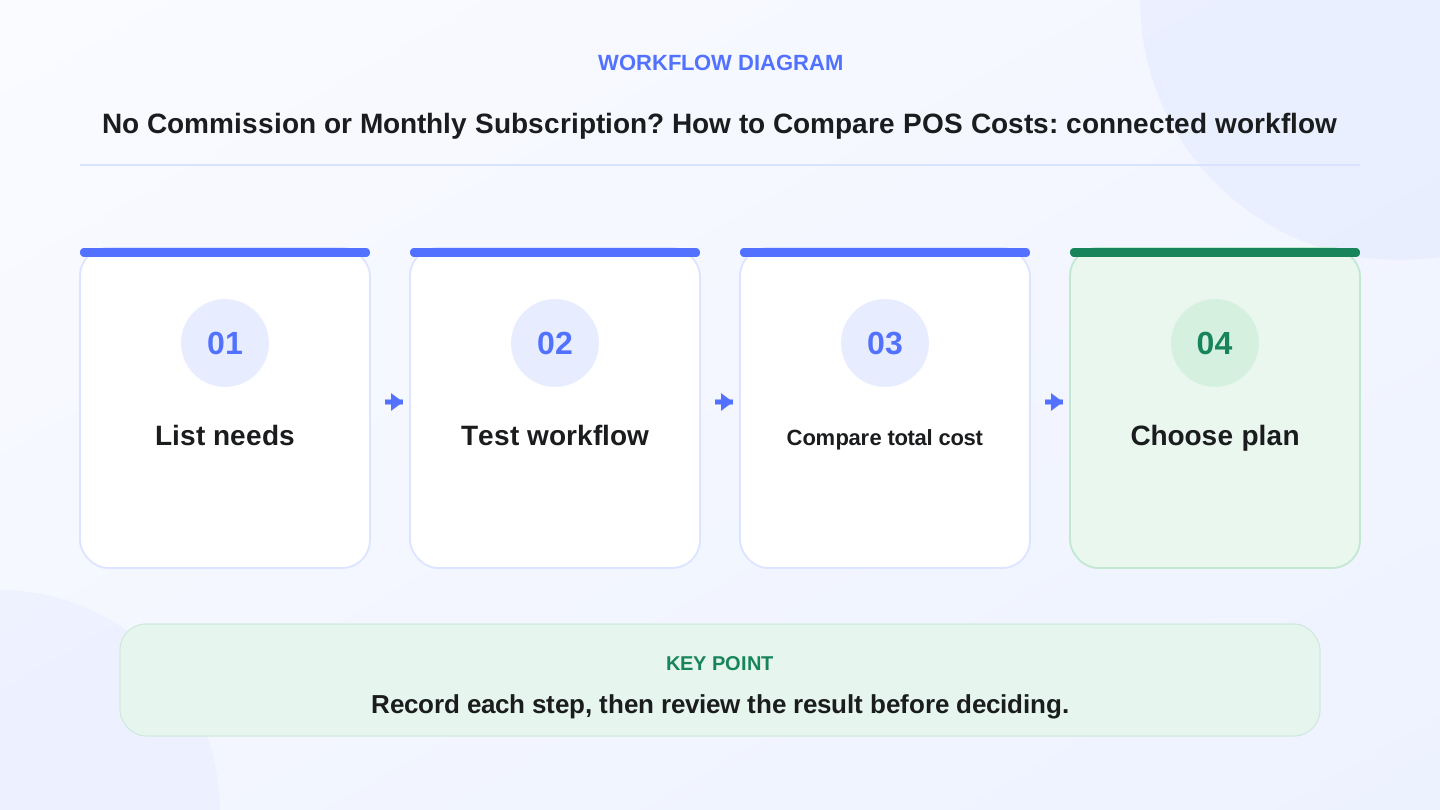
A practical sequence has four connected steps: List needs, Test workflow, Compare total cost, Choose plan. Recording each step makes the daily result easier to review.
03
What “no commission” should and should not mean
No commission should mean the platform itself does not take a sales percentage from your order value. It does not automatically mean every payment, delivery, domain, support, or operational cost disappears. Online payments may have their own processing costs, and cash on delivery still has delivery follow-up work.
Ask the provider to separate platform fees from payment fees and delivery fees. Also ask whether the storefront, custom domain, payment setup, logistics workflow, reports, and product limits are included or paid add-ons.
This is not legal, tax, or payment-processing advice. For formal payment, tax, or accounting decisions, verify with the relevant provider, authority, or qualified professional.
04
What “POS without monthly subscription” should be checked against
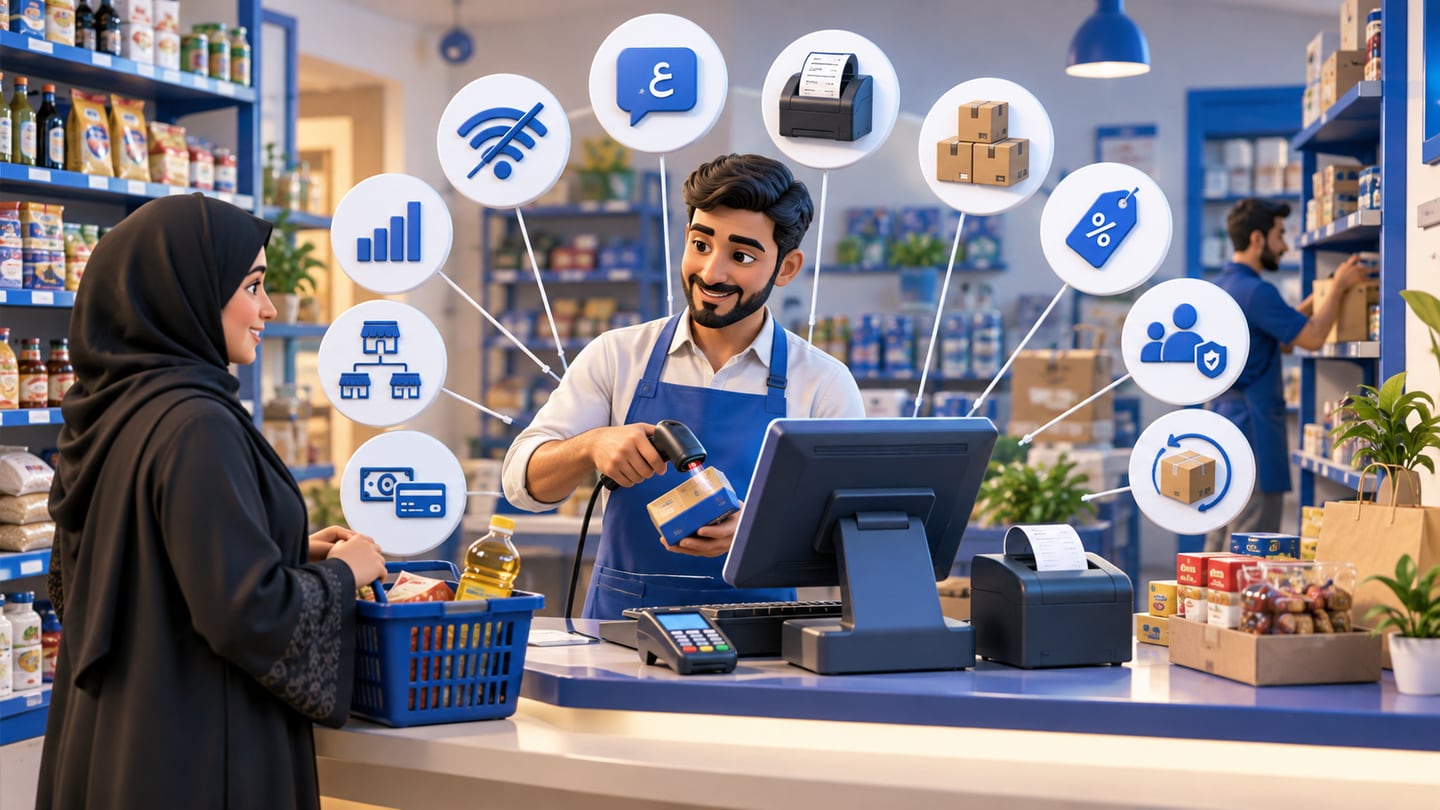
A POS without monthly subscription can be useful for very simple selling. But it still needs to support your actual workflow. Can it sell offline? Does it work in Arabic? Does it print receipts? Can it track inventory, purchases, discounts, roles, and returns? Can it show reports by item, cashier, branch, and payment method?
If the answer is no, the missing workflow becomes a manual task. Manual tasks are not free. They consume staff time, create errors, and make daily reports less trusted.
For a tiny owner-operated kiosk, a simple setup may be enough. For restaurants, cafés, retail shops, supermarkets, pharmacies, salons, and multi-branch businesses, the cost of weak operations often becomes higher than the cost of proper software.
05
Total-cost table for Iraq businesses
Use this table before comparing a free, commission-based, or subscription model.
The best model is not always the lowest row. It is the model with the lowest reliable operating cost for your business.
| Cost item | What to ask | Why it changes the real price |
|---|---|---|
| Software plan | Monthly, yearly, free, or one-time? | The headline fee is only the starting point |
| Commission | Is there a percentage on orders? | Important for online stores with growing sales |
| Payment fees | Card, wallet, gateway, COD handling? | Often separate from platform pricing |
| Ecommerce add-on | Storefront, domain, orders, stock sync? | Online selling can require extra tools |
| Hardware | Tablet, printer, barcode reader, cash drawer? | POS setup may need devices |
| Setup and support | Migration, training, installation, help? | Reduces failed rollout risk |
| Staff time | Manual entry, stock fixes, report building? | Hidden cost can exceed software fees |
| Errors | Overselling, wrong stock, missed purchases? | Mistakes damage margin and trust |
06
Worked example: commission versus subscription
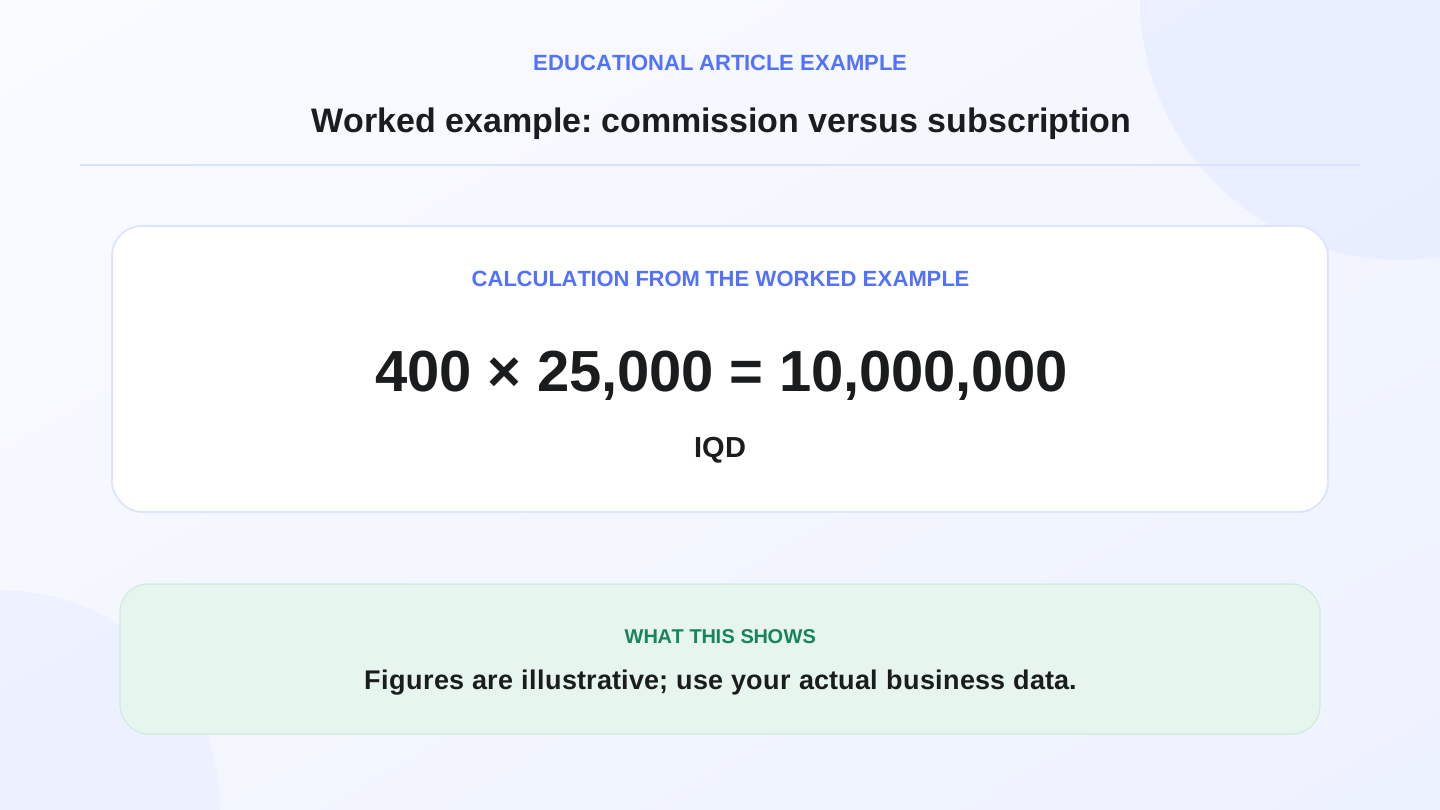
Assume an online store sells 400 orders per month with an average order value of 25,000 IQD. Monthly order value is 400 × 25,000 = 10,000,000 IQD.
If a platform commission is 2%, commission cost is 10,000,000 × 0.02 = 200,000 IQD per month. If another system has a predictable subscription and saves 18 staff hours monthly, and each hour is estimated at 6,000 IQD, staff time value is 18 × 6,000 = 108,000 IQD.
These numbers are illustrative. The owner should plug in real order volume, payment costs, staff cost, and current provider terms. The point is to compare models with math instead of slogans.
07
The inventory cost most pricing pages hide
Pricing pages rarely show the cost of wrong stock. If your online store and POS do not share inventory, the team may sell an item online after it was already sold in the shop. Then someone must call the customer, cancel the order, replace the item, or deliver late.
Inventory errors also affect purchasing. If the owner cannot trust stock levels, they may overbuy slow items and underbuy fast items. A connected system prevents some of that waste by updating stock from POS sales, purchases, adjustments, and ecommerce orders.
RA8M connects POS, inventory, purchases, finance, reports, branches, roles, and ecommerce. That connection is part of the cost comparison because it reduces manual reconciliation.

08
When a subscription can be fairer
A fair subscription is predictable and tied to operational value. It should help the business sell, track inventory, close cash, review reports, manage roles, and connect online orders. If it saves time every day, the daily cost may be reasonable.
For example, a 15,000 IQD monthly plan equals 15,000 ÷ 30 = 500 IQD per day. If the system saves even 10 minutes per day and prevents one stock mistake per month, the value may exceed the daily price. Public RA8M prices can change, so always verify the current pricing page before buying.
Do not buy a subscription only because it sounds professional. Buy it when the workflow and support justify it.
09
When simpler or free may be enough
A very small business with one owner, few products, no employees, no ecommerce, and no need for inventory reports may start with a simpler system. In that case, the priority is recording sales clearly and avoiding unnecessary complexity.
But once the business adds staff, branches, stock movement, supplier purchases, delivery, or online orders, the cost model changes. Manual correction becomes part of the bill. At that point, compare RA8M POS, RA8M Ecommerce, and pricing against the cost of staying manual.
10
Questions to ask before signing up
Ask whether the platform charges commission, what payment costs are separate, what ecommerce features are included, whether offline POS is supported, how Arabic and English workflows work, and how inventory syncs between the shop and online orders.
Also ask about support, data export, device requirements, staff roles, branch limits, and reports. A transparent answer is more valuable than a low price that hides conditions.
11
Conclusion: compare fairness, not only price
No commission and no monthly subscription are useful pricing ideas, but they are not the whole decision. Iraq businesses should choose the model that makes daily operations clearer, protects inventory, supports Arabic teams, and gives reliable reports. A predictable subscription can be fair when it saves time and reduces errors; a free tool can be fair when the operation is truly simple.
Frequently asked questions
Is a no-commission ecommerce platform always cheaper?
Not always. You still need to compare payment fees, delivery workflow, add-ons, staff time, support, inventory errors, and reporting work.
Is POS without monthly subscription better?
Only if it still supports your real workflow. A one-time or free POS can become expensive if it lacks inventory, offline selling, Arabic workflows, branches, or reports.
How should I compare POS cost in Iraq?
Compare daily cost, hardware, setup, training, support, ecommerce add-ons, staff time saved, stock errors prevented, and whether sales connect to inventory and finance reports.
Does RA8M charge commission?
Verify current commercial terms on RA8M pricing and ecommerce pages before buying. This article explains how to evaluate cost models, not a permanent pricing guarantee.
Written by
RA8M Team
Practical guides for restaurants, shops, and operations teams
Next step
Try RA8M with data close to your operation
Read next