Financial Statements for Iraqi Businesses: Four Reports, How They Connect, and Year-End Close
What financial statements mean for an Iraqi shop or restaurant: income statement, balance sheet, cash flow, and changes in equity, how they link after a balanced trial balance, illustrative IQD example, year-end closing and owner capital, and Ra8m BalanceSheetReport, ProfitLossReport, and JournalEntriesTab.
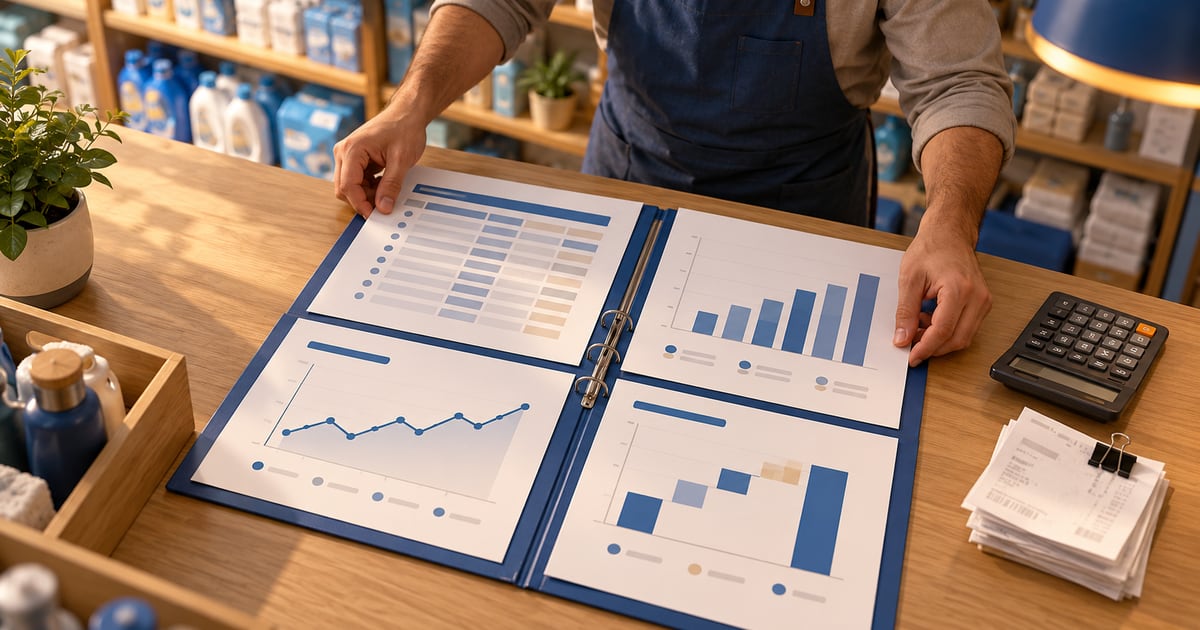
Financial statements for an Iraqi business are a linked set: income statement for a period, balance sheet on one date, cash flow for cash movement, and changes in equity for capital and retained earnings. Build them after double-entry and a balanced trial balance. In Ra8m, BalanceSheetReport and ProfitLossReport in Business reports plus JournalEntriesTab for journals—no invented cash-flow report name.
01
Financial Statements for Iraqi Businesses: Four Reports, How They Connect, and Year-End Close
Your cashier knows today’s sales; the bank knows what cleared; your accountant asks for financial statements Iraq shops can defend. Financial statements are not one file—they are a package linking performance (profit and loss), position (balance sheet), cash timing (cash flow), and the owner story (changes in equity and owner capital). Mini-markets, restaurants, and pharmacies use the same structure whether you export a financial statements PDF for a partner or review numbers before a loan.
This guide assumes double entry bookkeeping in Iraq and a trial balance for Iraqi businesses that ties before you build statements—because IAS 1 Presentation of Financial Statements assumes complete records. Pair it with accounting principles in Iraq, accounts receivable and payable, depreciation for Iraqi businesses, and accounting software for small business in Iraq. For daily posting in Ra8m—Arabic-first POS, ecommerce, offline selling, and Boxy delivery on ecommerce plans—confirm live plans on pricing.
Quick answer: Financial statements Iraq businesses prepare combine an income statement (period), balance sheet (one date), cash flow statement (cash movement), and statement of changes in equity (capital and retained earnings). Build them after a balanced trial balance from journal entries—not from drawer guesses. In Ra8m, BalanceSheetReport and ProfitLossReport in Business reports plus JournalEntriesTab for audit trails; formal cash flow and equity statements are often completed by your accountant from the same ledgers—we do not invent report names that are not in the product.
02
Financial Statements for Iraqi Businesses: Four Reports, How They Connect, and Year-End Close

03
What financial statements are—and which to read first
This article assembles the full picture without duplicating every line in the dedicated balance sheet and profit and loss guides. The trial balance proves books tie; statements translate balances into bank language.

| Question | Statement | In one line |
|---|---|---|
| Did we earn or lose? | Income statement | Revenue minus COGS and expenses over a **period** |
| What do we own and owe? | Balance sheet | Assets = liabilities + equity on **one date** |
| When did cash move? | Cash flow statement | Operating, investing, financing—timing differs from profit |
| What happened to capital? | Changes in equity | Capital, retained earnings, drawings |
04
How the four statements connect
Logical links:
1. The income statement ends the period with net profit or loss.
2. Changes in equity (or closing entries) move that result into retained earnings.
3. The balance sheet shows retained earnings inside equity beside owner capital.
4. The cash flow statement explains why cash on the balance sheet is not “this month’s profit.”

| Illustrative event | Income statement | Balance sheet | Cash flow |
|---|---|---|---|
| Credit sale | Revenue recognized | Receivables up | No cash until collection |
| Cash stock purchase | Not full expense yet (COGS later) | Inventory up, cash down | Operating outflow |
| Rent paid | Expense | Cash down | Operating outflow |
| Depreciation entry | Expense | Accumulated depreciation up | Usually non-cash |
05
Income statement and balance sheet: what the dedicated articles cover
The income statement answers period performance. See profit and loss calculation in Iraq for net sales, COGS, and expenses. In Ra8m, ProfitLossReport in Business reports summarizes revenue, cost of sales, expenses, and net profit for the selected range—when your chart of accounts and posting stay consistent.
The balance sheet is a one-date snapshot. See balance sheet for small businesses in Iraq for assets, liabilities, and owner capital. BalanceSheetReport reads your chart of accounts and balance sheet transactions from sales, purchases, inventory, expenses, and customer credit.
06
Cash flow and changes in equity: ledgers and accountant role
The cash flow statement tracks when cash entered and left. Cash flow in Iraq focuses on operational calendars; formal presentation follows IAS 7. Ra8m does not market a fake cash-flow report name here—use JournalEntriesTab for cash and bank trails, then let your accountant classify flows.
Changes in equity explain opening capital, plus net profit, minus drawings, plus capital injections. If you skip a separate statement, BalanceSheetReport, ProfitLossReport, and JournalEntriesTab should still tell one story.
07
Worked example: “Karrada Kitchen” restaurant (illustrative IQD)
Karrada Kitchen (illustrative) in Baghdad closes a management year. Numbers are illustrative—replace every cell with your Ra8m export.
Quick tie: Net profit 42,000,000 increases retained earnings after illustrative drawings of 15,700,000 during the year (26,300,000 ≈ opening + profit − drawings—verify with your accountant). Cash 38,500,000 is below “year profit” because credit sales and early stock buys moved timing—what a cash flow statement explains.
| Line | IQD |
|---|---|
| Dine-in and delivery sales | 420,000,000 |
| Cost of sales (food) | (168,000,000) |
| **Gross profit** | **252,000,000** |
| Wages, rent, utilities | (198,000,000) |
| Depreciation | (12,000,000) |
| **Net profit** | **42,000,000** |
08
Year-end closing: closing accounts in shop ledgers
Year-end closing (closing the books) means—under accountant guidance—moving revenue and expense balances to income summary then retained earnings, leaving assets and liabilities with opening balances for the next year. Practical steps:
1. Confirm the trial balance ties on the closing date.
2. Review JournalEntriesTab for large manual journals (depreciation, stock adjustments).
3. Open ProfitLossReport for the full period and BalanceSheetReport on the last day.
4. Post closing entries your accountant specifies—do not change owner capital except through explicit journals (capital injection or drawings).

| Common mistake | Why it hurts | Safer habit |
|---|---|---|
| Close before stock count | Misstated COGS and profit | Count, then adjustment journal |
| Mix personal drawings | Wrong equity | Separate drawings account |
| PDF from two different months | Bank rejects pack | One cutoff date |
09
How Ra8m supports the statement pack without fake names
POS records sales; purchase bills and expenses feed COGS and inventory; receipt and payment vouchers move cash and balances. For kitchens and manufacturing, Manufacture and Advanced plans; for storefront and Boxy, ecommerce from 50,000—verify on `/en/pricing`.
| Tool | Role in statements |
|---|---|
| **JournalEntriesTab** | Source of truth for debits and credits |
| **ProfitLossReport** | Operational income statement |
| **BalanceSheetReport** | Balance sheet from chart of accounts |
| **Chart of accounts** | Maps capital, depreciation, receivables |
10
Financial statements workshop for Iraqi shop owners
Treat a financial statements PDF as one pack: as-of date, trial balance, ProfitLossReport, BalanceSheetReport, and a note on cash and capital. ### workshop checkpoints before Sources deepen one line each quarter.
Workshop checkpoint: net profit vs retained earnings movement
When you review financial statements Iraq exports, pause on net profit versus retained earnings movement before you email a PDF. Open ProfitLossReport and BalanceSheetReport for the same year, then JournalEntriesTab for owner drawings and capital journals. Write: “Profit X + opening Y − drawings Z = closing W.”
Workshop checkpoint: balance sheet cash vs monthly profit
When you review statements, compare cash on BalanceSheetReport with net profit—do not assume they match. Use cash flow and JournalEntriesTab for credit collections and stock purchases.
Workshop checkpoint: receivables after delivery season
When you review statements, tie receivables on the balance sheet to customer account statements and JournalEntriesTab before PDF export.
Workshop checkpoint: inventory and COGS
When you review statements, confirm ProfitLossReport and BalanceSheetReport use the same inventory policy you agreed with your accountant—see cost of goods sold for Iraq shops.
Workshop checkpoint: depreciation journals before close
When you review statements, check depreciation journals in JournalEntriesTab before year-end closing.
Workshop checkpoint: trial balance before export
When you review statements, rebuild the trial balance from chart of accounts—if it does not tie, do not ship a PDF pack.
11
Honest limits and when to call an accountant
Software does not choose tax policy or full IFRS presentation. Ra8m records documents and shows BalanceSheetReport and ProfitLossReport—it does not replace an accountant for year-end close or a formal cash flow statement. The SBA finance guide separates bookkeeping checks from owner decisions.
12
Sources and standards
IAS 1 — Presentation of Financial Statements — complete records before presentation.
IAS 7 — Statement of Cash Flows — cash flow framework.
Before you send a financial statements PDF, confirm the cutoff matches stock count and cash count. Explain differences in one memo instead of silently adjusting balances.
When you share the pack with a bank, attach a short trial balance or JournalEntriesTab summary for large movements—not the balance sheet page alone. If the shop used offline mode in Ra8m, sync before close so last-week invoices are not missing from ProfitLossReport.
13
Conclusion
Useful financial statements Iraq owners rely on are linked and dated: ProfitLossReport for performance, BalanceSheetReport for position, JournalEntriesTab for evidence, and a balanced trial balance underneath. Read details in the balance sheet, profit and loss, and trial balance guides, then execute year-end closing with your accountant.
14
Frequently Asked Questions
What are financial statements for a small business in Iraq?
A linked report package from complete ledgers—usually income, balance sheet, cash flow, and changes in equity.
How are financial statements different from a trial balance?
The trial balance proves debits equal credits; statements tell a bank-ready story.
Can I download financial statements PDF?
Yes—after review and a consistent as-of date.
Where are balance sheet and P&L in Ra8m?
BalanceSheetReport and ProfitLossReport in Business reports; journals on JournalEntriesTab.
What does year-end closing mean?
Moving revenue and expense to retained earnings at period end—under accountant guidance.
How does owner capital appear?
In equity on the balance sheet; changes post through double entry.
Does Ra8m ship all four statements ready-made?
Balance sheet and P&L come from the app; formal cash flow and equity statements are often finished by your accountant from the same ledgers.
Frequently asked questions
What are financial statements for a small business in Iraq?
A linked package—usually income statement, balance sheet, cash flow, and changes in equity—built from complete ledgers. Shops use them for banks, partners, and accountants—not as a tax return alone.
How are financial statements different from a trial balance?
The trial balance proves debits equal credits for every account. Statements group accounts into performance, position, cash, and ownership stories. Start with a tied trial balance, then present statements.
Can I download financial statements PDF?
Many shops export from software or build a PDF after accountant review. Use one as-of date and do not mix two months on one page.
Where are balance sheet and P&L in Ra8m?
Business reports: BalanceSheetReport for the balance sheet and ProfitLossReport for profit and loss. JournalEntriesTab proves the journals behind the numbers.
What does year-end closing mean?
Posting revenue and expense balances to retained earnings (or a summary account) at period end—on your accountant’s instruction—then preparing annual statements.
How does owner capital appear?
Capital sits in equity on the balance sheet. Drawings or capital injections post through double entry and appear in changes in equity when prepared.
What Ra8m plans support finance posting?
Confirm live pricing: Basic 7,500 IQD/month, Advanced 15,000, Manufacture 30,000, ecommerce from 50,000—verify on /en/pricing before you buy.
Written by
RA8M Team
Practical guides for restaurants, shops, and operations teams
Next step
Try RA8M with data close to your operation
Read next
Related RA8M guides
Accounting and Finance
Raw Materials Management for Small Manufacturers in Iraq: Receive, Store, Cost, and Produce
Read article
Accounting and Finance
Cost Accounting for Small Businesses in Iraq: Unit Cost, COGS, and Margin
Read article
Accounting and Finance
Accounting Principles for Iraqi Businesses: Financial vs Managerial, Bookkeeping, IQD Exercises
Read article
Accounting and Finance
Accounts Receivable and Payable in Iraq: الذمم المدينة, Aging, and Ra8m Credit
Read article
Accounting and Finance
Double Entry Bookkeeping in Iraq: القيد المزدوج, IQD Journals, and Ra8m Posting
Read article