Delivery Service for Online Stores in Iraq: POS and Order Workflow
A practical guide for Iraq ecommerce sellers planning delivery service workflows, from checkout and stock reservation to courier handoff, COD, returns, and reports.

A delivery service for an online store should connect checkout, stock reservation, order confirmation, courier handoff, payment status, returns, and reporting. In Iraq, stores often need cash on delivery plus digital payment options, clear Arabic instructions, accurate delivery areas, and POS-connected inventory so online orders do not conflict with in-store sales.
01
Delivery Service for Online Stores in Iraq: POS and Order Workflow
Delivery service for an online store is not only choosing a courier. The store must control checkout promises, stock availability, order confirmation, payment status, delivery handoff, failed deliveries, returns, and end-of-day reports.
Quick answer: A delivery service for an online store should connect checkout, stock reservation, order confirmation, courier handoff, payment status, returns, and reporting. In Iraq, stores often need cash on delivery plus digital payment options, clear Arabic instructions, accurate delivery areas, and POS-connected inventory so online orders do not conflict with in-store sales.
02
What does delivery service mean for an online store?
For ecommerce, delivery service means the complete movement from an online order to the customer. It includes choosing delivery areas, showing delivery fees, collecting address details, confirming the order, preparing items, handing the package to a courier or internal driver, and recording the final status.
The courier is only one part. If the store accepts orders without checking stock, address quality, payment method, or delivery capacity, the team may spend more time correcting orders than fulfilling them.
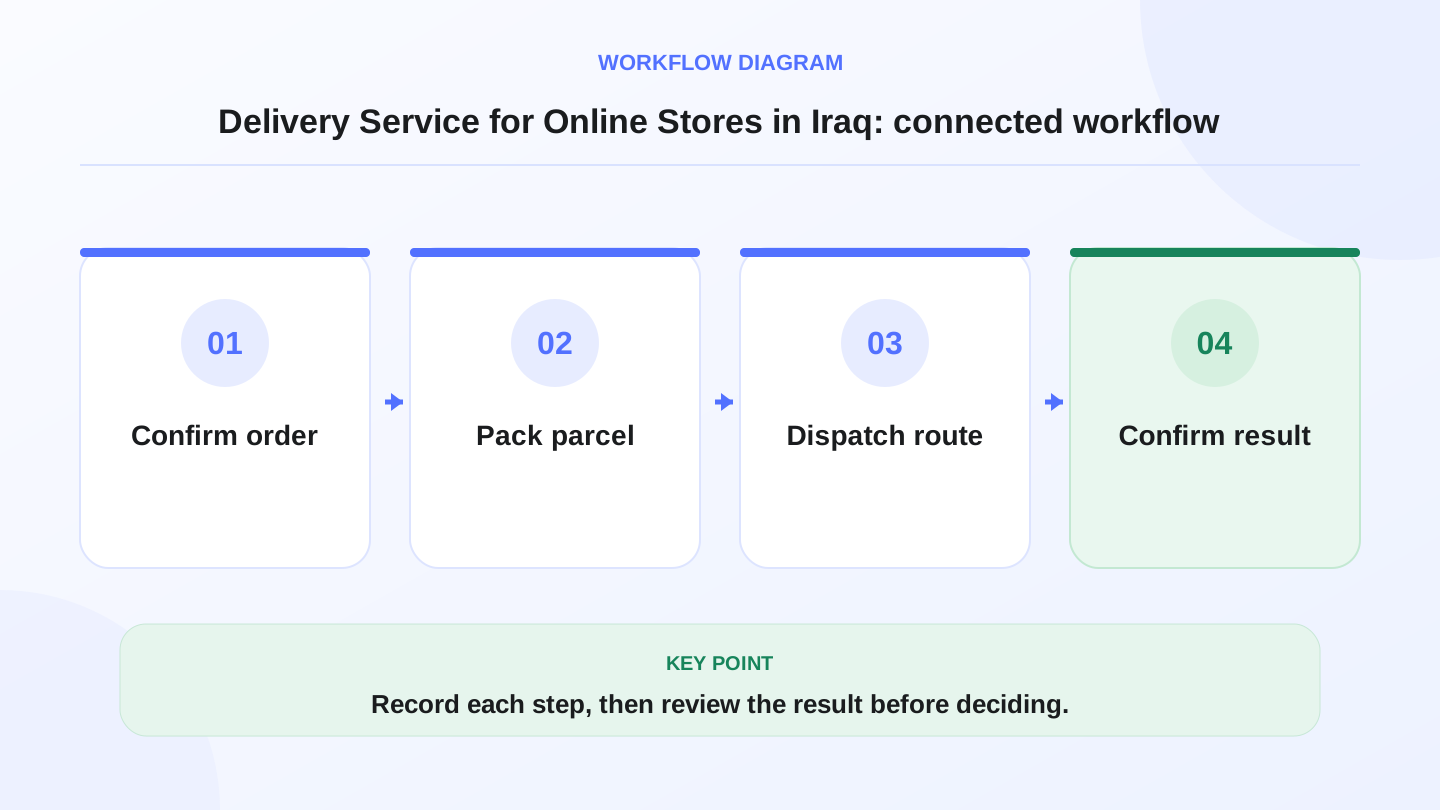
A practical sequence has four connected steps: Confirm order, Pack parcel, Dispatch route, Confirm result. Recording each step makes the daily result easier to review.
03
Why Iraq stores need delivery rules before launch
Iraq ecommerce often combines online browsing, phone confirmation, WhatsApp follow-up, cash on delivery, digital payment options, and local courier coverage. Customers may expect fast responses, but delivery areas and fees can vary by city, neighborhood, item size, and provider.
Before launching, define where you deliver, what happens outside the area, how COD is confirmed, who calls the customer, when stock is reserved, and how failed deliveries are recorded. Clear rules reduce customer confusion and staff arguments.
04
Delivery workflow checklist
Use this table before opening orders. It makes delivery a repeatable workflow instead of daily improvisation.
| Step | Decision to make | Operational reason |
|---|---|---|
| Delivery area | Cities, zones, neighborhoods, pickup option | Prevents orders from unsupported locations |
| Delivery fee | Flat fee, zone fee, free threshold, or manual quote | Sets customer expectations before confirmation |
| Payment method | COD, card, wallet, bank transfer, or mixed options | Affects risk, reconciliation, and courier collection |
| Stock status | Reserve at order, payment, or confirmation | Prevents selling the same item twice |
| Courier handoff | Internal driver, courier company, Boxy, or pickup | Clarifies who owns each package |
| Failed delivery | Reattempt, cancel, return to stock, or fee policy | Keeps reports and inventory clean |
| Reports | Orders by status, channel, payment, item, and area | Helps the owner improve delivery decisions |
05
Worked example: delivery capacity and order timing
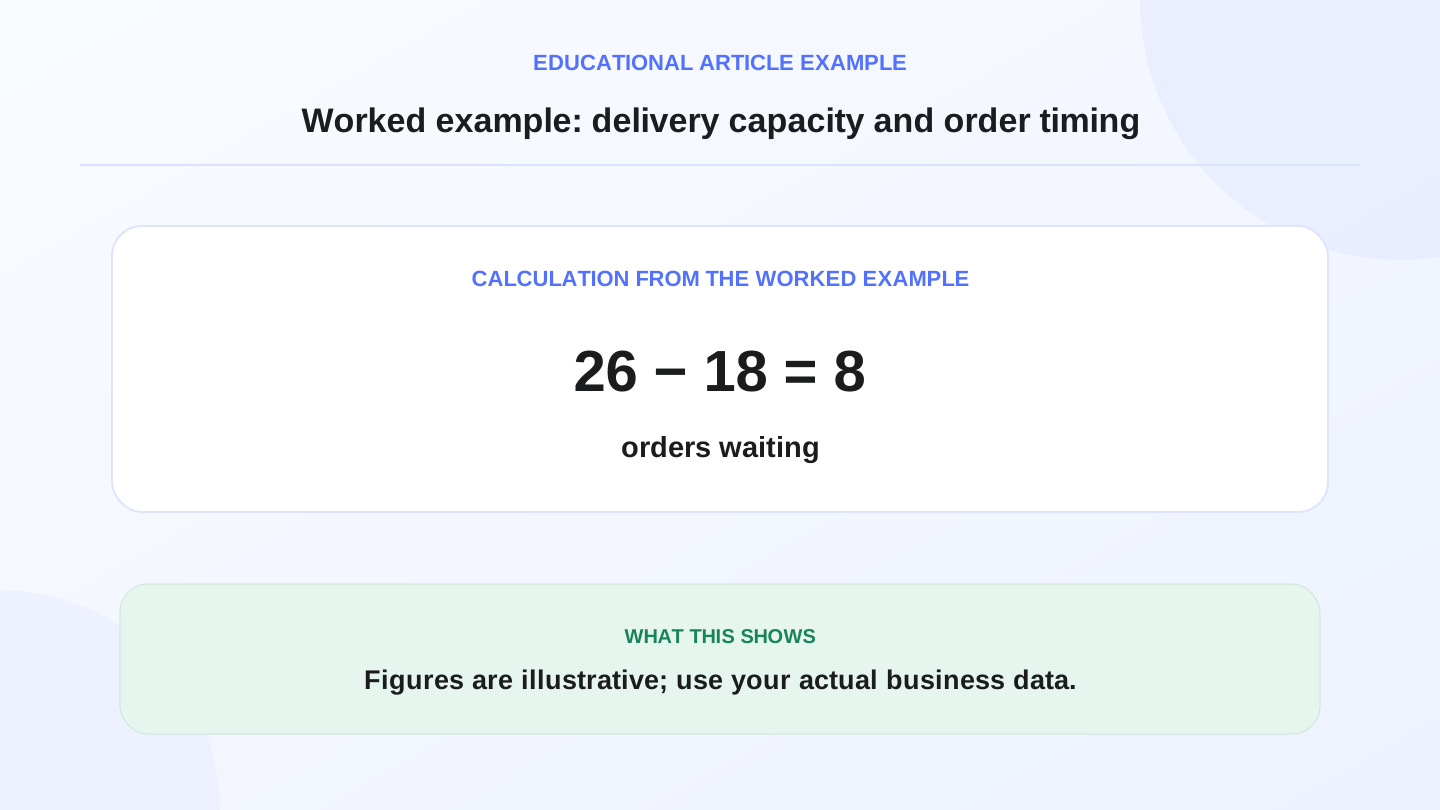
Assume a store has one driver who can complete 18 deliveries per day. The online store receives 26 orders by 2 PM. If all are promised for same-day delivery, the backlog is 26 - 18 = 8 orders.
The store now has three choices: add another delivery route, move 8 orders to next-day delivery with customer confirmation, or stop same-day promises after capacity is full. Without this calculation, staff may promise delivery the business cannot complete.
06
Cash on delivery, online payment, and risk
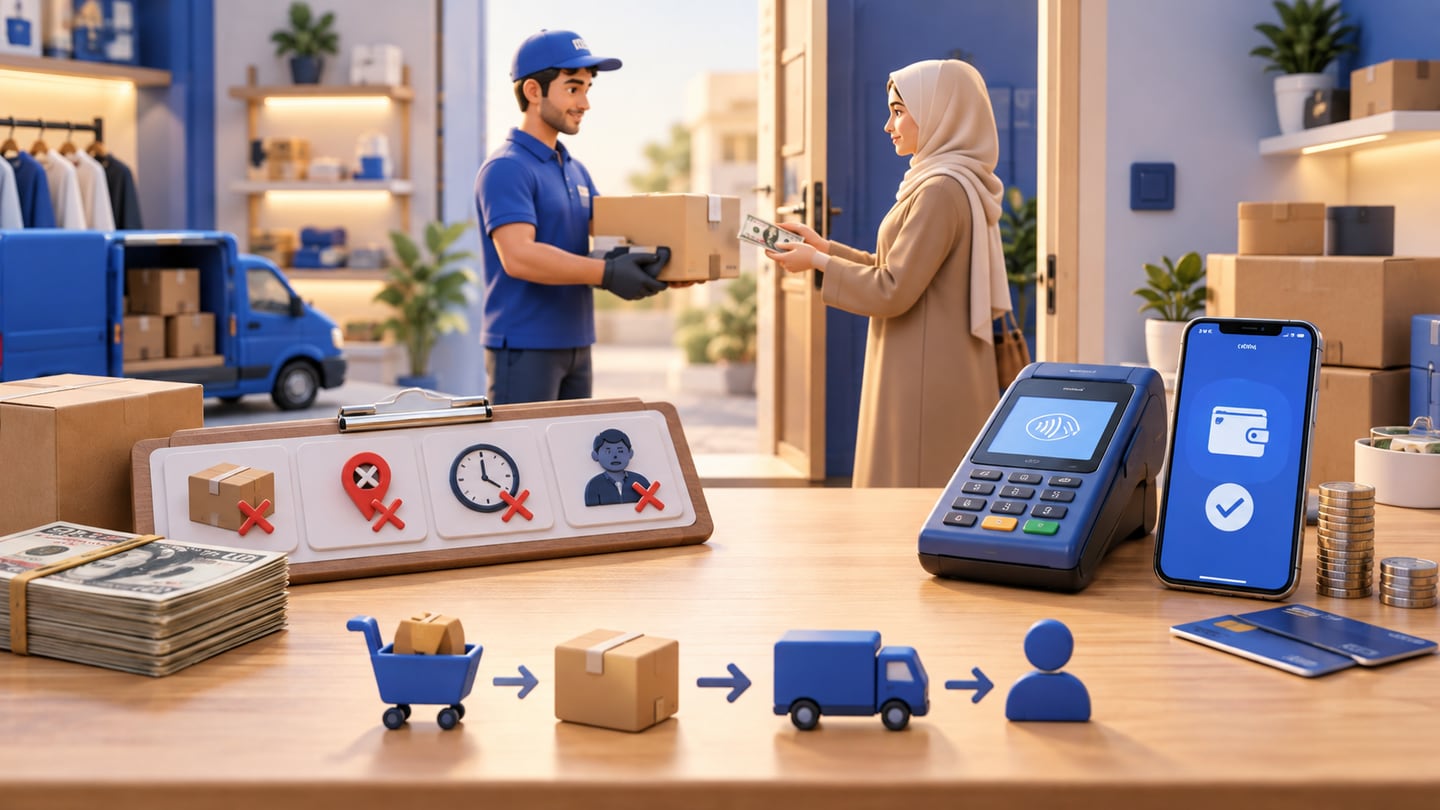
Cash on delivery is still useful for many Iraq stores because some customers prefer paying at the door. But COD also adds risk: refused packages, wrong address details, unavailable customers, and cash reconciliation with drivers.
Digital payments may reduce some risk, but provider availability, fees, settlement, refund process, and integration requirements must be verified. Many stores use a mixed setup: COD for familiar customers or categories, online payment where available, and clear confirmation for high-value items.
07
Why delivery must connect to inventory
Delivery orders are stock commitments. If an online order is confirmed but inventory is not reserved, the same item may be sold at the cashier before the package is prepared. This is common when the website and POS use separate product lists.
A POS-connected ecommerce setup reduces the conflict. When online and in-store sales share products and stock, the team sees more accurate availability. RA8M Ecommerce is designed to connect online storefronts with POS products, inventory, orders, payments, and delivery workflows. Review RA8M Ecommerce with RA8M POS if stock accuracy is a major issue.
08
Returns and failed delivery handling
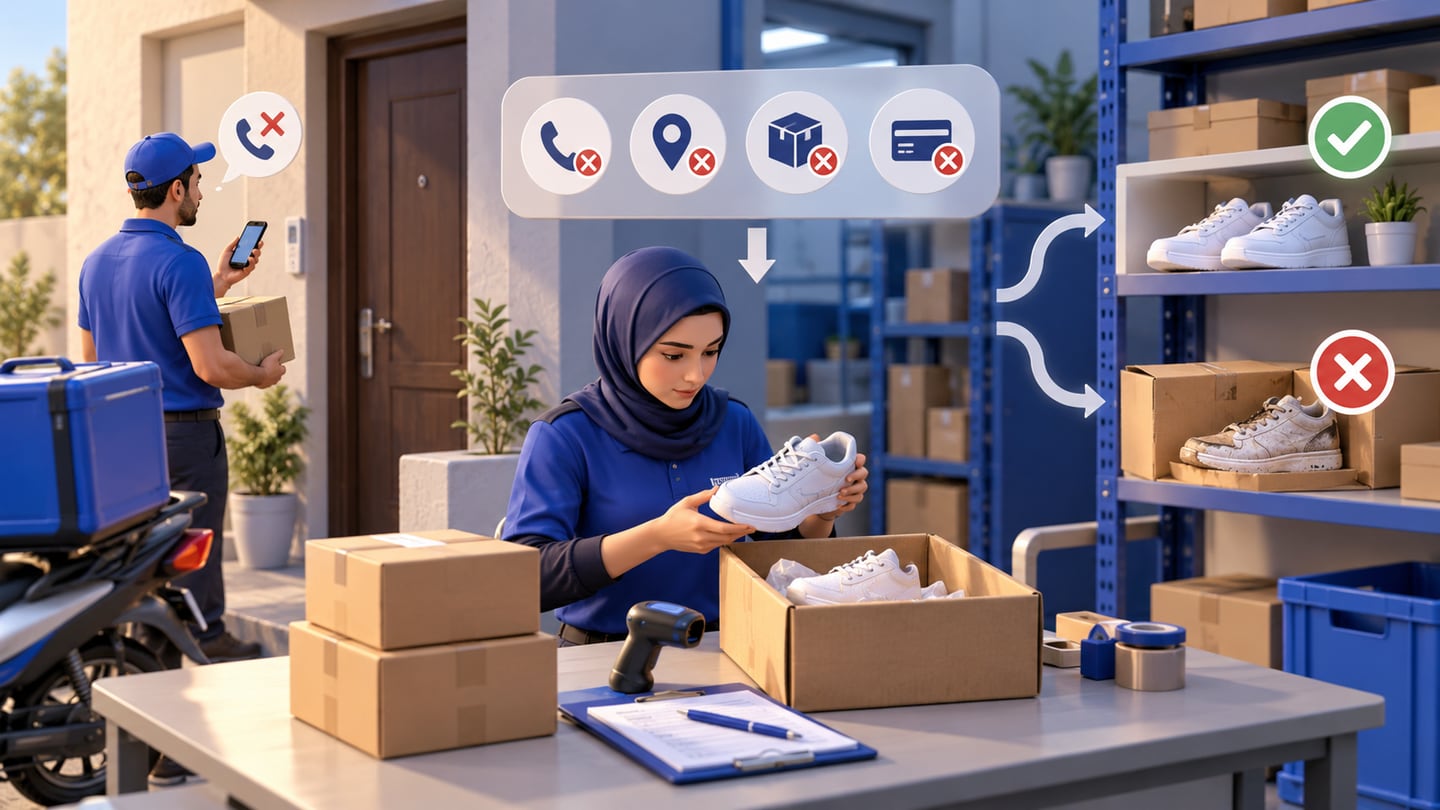
Delivery does not end when the package leaves the store. Some orders fail because the customer does not answer, the address is wrong, the item is rejected, or the payment cannot be collected. The system should record the status and decide whether stock returns to available inventory.
For returned items, staff should inspect product condition before resale. If the item is damaged, it may need an adjustment instead of normal stock return. Clear status names help accounting and operations understand what happened.
09
Reports owners should review
Delivery reports should answer practical questions: Which area creates the most orders? Which area has failed deliveries? Which courier is fastest? Which products are returned often? How much COD cash is still with drivers? How many orders are pending, packed, out for delivery, delivered, cancelled, or returned?
These reports matter because delivery affects profit, customer trust, and inventory accuracy. A growing online store needs more than order notifications; it needs operating data.
10
When a simpler setup may be enough
A new store with a few orders per week may start with manual confirmation, COD, and one delivery partner. That can be enough if the owner personally checks every order and updates stock immediately.
Upgrade when order volume grows, staff handle fulfillment, products sell in-store and online, delivery areas expand, COD reconciliation becomes slow, or customers need clearer order status. At that stage, delivery should connect with POS, inventory, payments, and reports.
11
Where RA8M fits
RA8M fits Iraq businesses that want ecommerce delivery to be part of one operating system. It is relevant for retailers, supermarkets, restaurants, cafés, salons, pharmacies, and sellers moving from Instagram or WhatsApp orders to a structured online store.
RA8M Ecommerce adds a branded storefront connected to POS products and stock. Public materials describe payment and Boxy logistics capabilities, but availability and commercial terms can change. Verify current pricing on RA8M pricing, and confirm delivery provider details before promising customers.
12
Conclusion
Delivery service for an online store should be planned as a full order workflow: area, fee, checkout, payment, stock, courier, return, and report. If those parts are not clear, delivery becomes a source of cancelled orders and manual correction.
Start with the checklist, calculate capacity, and connect online orders to inventory. If you need online and in-store operations in one place, explore RA8M Ecommerce and review industries for common business workflows.
13
FAQs
What should an online store delivery workflow include?
It should include delivery area rules, checkout instructions, stock reservation, order confirmation, courier handoff, payment status, failed delivery handling, returns, and reports.
Is cash on delivery still important in Iraq ecommerce?
Yes, many stores keep cash on delivery because customer preferences vary. It should be managed with clear order confirmation, delivery risk controls, and daily reconciliation.
Why connect delivery orders to POS inventory?
Connecting delivery orders to POS inventory prevents overselling, keeps staff aligned, and helps the owner compare online orders with in-store sales and stock movements.
How does RA8M help online store delivery?
RA8M Ecommerce connects the storefront with POS products, inventory, orders, payments, delivery workflows, and reports so the team can manage online and in-store selling together.
Frequently asked questions
What should an online store delivery workflow include?
It should include delivery area rules, checkout instructions, stock reservation, order confirmation, courier handoff, payment status, failed delivery handling, returns, and reports.
Is cash on delivery still important in Iraq ecommerce?
Yes, many stores keep cash on delivery because customer preferences vary. It should be managed with clear order confirmation, delivery risk controls, and daily reconciliation.
Why connect delivery orders to POS inventory?
Connecting delivery orders to POS inventory prevents overselling, keeps staff aligned, and helps the owner compare online orders with in-store sales and stock movements.
How does RA8M help online store delivery?
RA8M Ecommerce connects the storefront with POS products, inventory, orders, payments, delivery workflows, and reports so the team can manage online and in-store selling together.
Written by
RA8M Team
Practical guides for restaurants, shops, and operations teams
Next step
Try RA8M with data close to your operation
Read next
Related RA8M guides
Payments and Delivery in Iraq
Cash on Delivery and Delivery Services for Online Stores in Iraq
Read article
Best-in-Iraq Comparisons
POS Software Comparison in Iraq: Features, Cost and Fit
Read article
All-in-One Business Management
Sales and Inventory Management System in Iraq: POS Workflow Guide
Read article