Arabic Ecommerce Platform in Iraq: What to Check Before Launch
A practical guide for Iraq businesses choosing an Arabic ecommerce platform that connects products, inventory, POS, orders, payments, delivery and reports.

An Arabic ecommerce platform in Iraq should support Arabic RTL shopping, IQD prices, clear product pages, connected inventory, order management, payment or cash-on-delivery workflows, delivery tracking, and daily reports. The most important check is whether the online store shares product and stock data with the POS, so teams do not sell unavailable items.
01
Arabic Ecommerce Platform in Iraq: What to Check Before Launch
An Arabic ecommerce platform is not just a translated website template. For Iraq businesses, it must serve the customer, the cashier team, the inventory process, and the owner: Arabic RTL shopping, IQD prices, structured orders, stock connected to POS, payment or cash-on-delivery workflows, and clear daily reporting.
Quick answer: An Arabic ecommerce platform in Iraq should support Arabic RTL shopping, IQD prices, clear product pages, connected inventory, order management, payment or cash-on-delivery workflows, delivery tracking, and daily reports. The most important check is whether the online store shares product and stock data with the POS, so teams do not sell unavailable items.
02
Why this is more than an online storefront
A business owner in Baghdad, Basra, Erbil, Najaf, or Mosul does not only need a page that looks modern. They need an operating workflow. Can the customer understand the product? Can staff read the order? Does the item quantity change after an online sale? Does the cashier stock match the website stock? Can the owner review daily sales without collecting messages from several apps?
Those questions matter because ecommerce often starts informally. A shop may receive orders through Instagram, WhatsApp, a simple form, and in-store sales at the same time. That can work for a small test, but it becomes fragile when order volume grows. A real Arabic ecommerce platform should organize the flow instead of adding another disconnected channel.
03
What makes a platform truly Arabic-first?
Arabic-first does not only mean Arabic labels. The shopping journey should be comfortable in right-to-left text, product names should be readable, receipts and order details should make sense to Arabic-speaking staff, and the business should still support English where needed. Iraq teams are often mixed: the owner may review English reports, while the cashier or fulfillment team works mainly in Arabic.
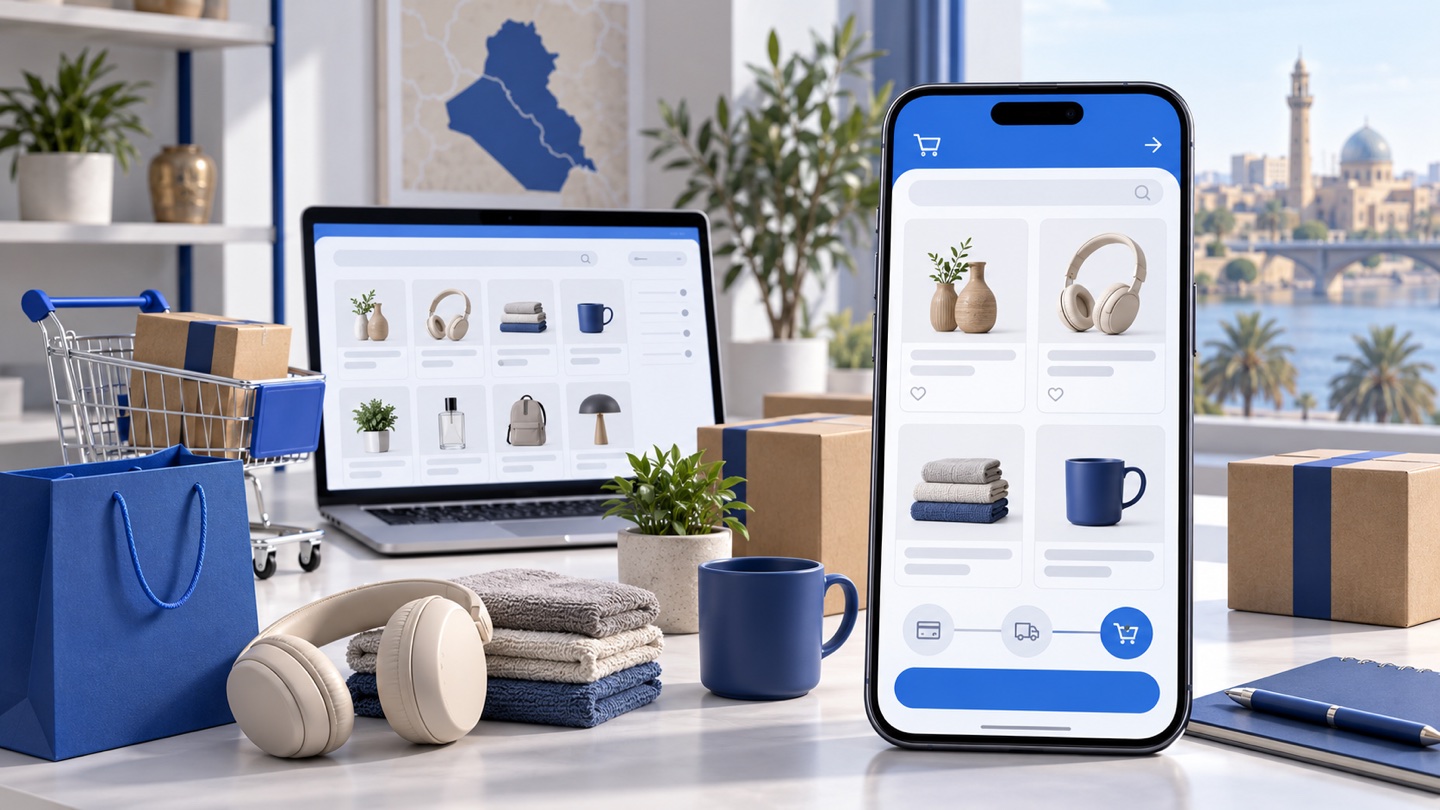
The platform should also handle local expectations: IQD pricing, clear phone and address fields, practical delivery notes, and payment options the business can actually operate. RA8M, also written Raqm or رقم, is positioned as an Arabic-first POS and ecommerce platform, so the ecommerce experience should not feel like a foreign system patched for Arabic after the fact.
04
Storefront versus ecommerce platform
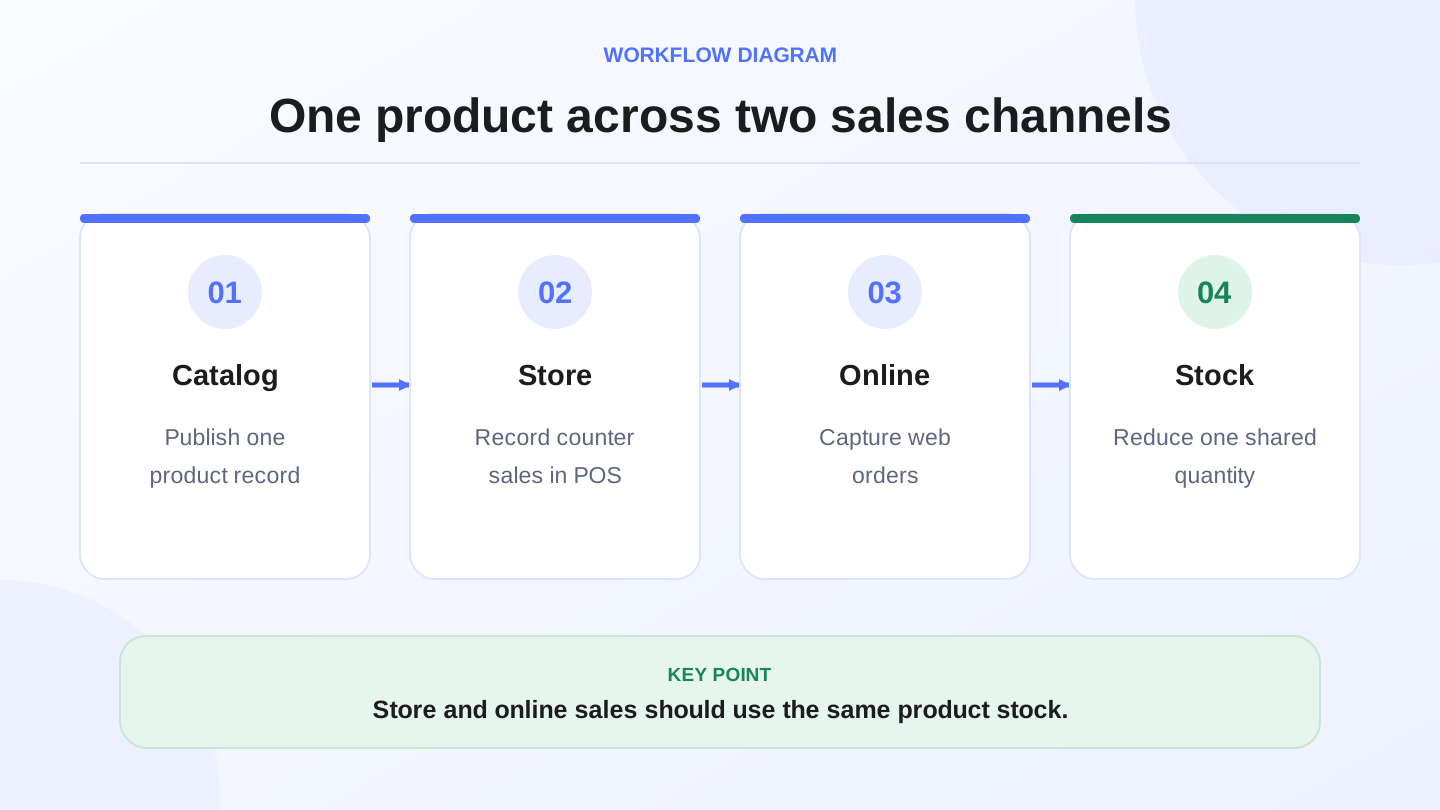
The storefront is what the customer sees: product pages, cart, checkout, order form, and delivery details. The ecommerce platform is the operating system behind it: products, stock, order states, payments, delivery workflows, reports, staff roles, and connections to POS.
This distinction is important. A standalone storefront may look good but still create manual work. If the cashier sells the last two units in-store and the website still shows them available, the store accepts a bad order. A better setup connects the online store with the POS and stock database. RA8M Ecommerce is designed around that connected idea; the online store can work with RA8M ecommerce, POS operations, and owner reports instead of operating as a separate island.
05
Comparison table: what to check before choosing
| Area to check | Practical question | Why it matters in Iraq |
|---|---|---|
| Arabic and RTL | Are product pages, checkout and order details clear in Arabic? | Staff and customers avoid confusion |
| POS inventory sync | Does stock decrease after in-store and online sales? | Prevents selling items that are not available |
| Order management | Are order states visible from new to completed? | Helps staff prepare and deliver correctly |
| Payment and COD | Can the business run cash on delivery or available payment options? | Matches common local buying behavior |
| Reports | Can the owner see online and in-store performance together? | Supports faster daily decisions |
06
Why POS integration changes the business case
The turning point is when the online store and the POS stop acting like two separate businesses. If a shop sells three items inside the branch and two items online, the remaining stock should reflect both movements. Without integration, staff must update the website manually, and manual updating is exactly where mistakes appear during busy hours.
Connected POS and ecommerce also helps with pricing discipline. If the product list is managed in one place, the owner can reduce duplicate names, inconsistent variants, and forgotten items. The result is not only a nicer customer experience; it is also cleaner operations for the team.
07
Worked example: inventory after online and in-store sales
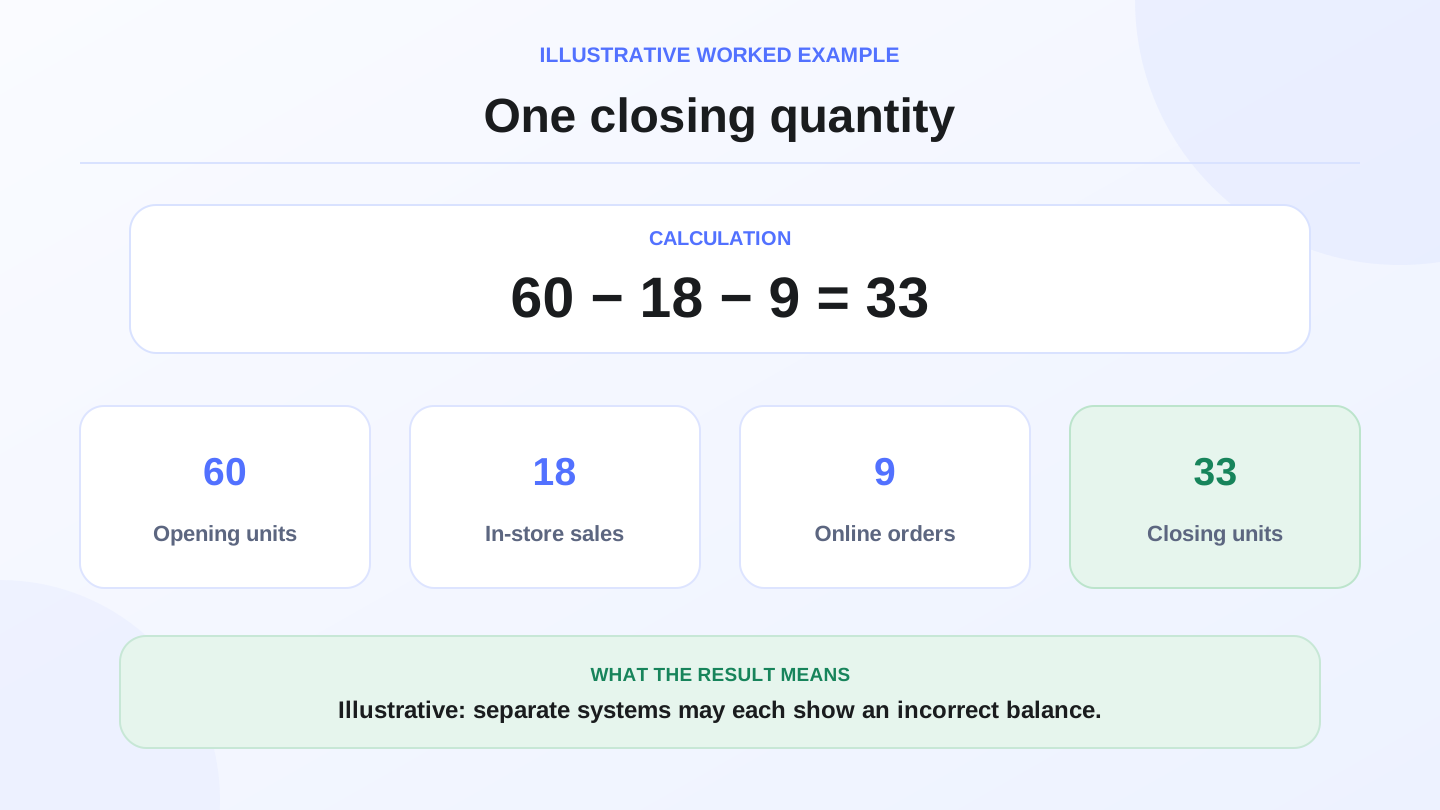
Imagine a cosmetics shop starts the day with 60 units of one product. During the day, the cashier sells 18 units in the store, and the online store receives 9 orders for the same product.
The expected closing stock is:
`Expected stock = 60 opening units - 18 in-store sales - 9 online orders = 33 units`
If the online store is not connected to POS, it may still show 42 units after the in-store sales or 51 units after the online orders. Both numbers are wrong because each system sees only part of the day. A connected ecommerce platform should reduce this gap by using one product and stock source.
08
Payment, delivery and realistic claims
Ecommerce in Iraq often includes cash on delivery, wallet or transfer workflows where available, and card payments when the business has a supported setup. Do not choose a platform only because it lists many payment names. Check what is actually active for your account, who reconciles payment, and how the team handles failed or changed orders.
The same applies to delivery. A delivery field is not a delivery process. Staff need order states, customer contact details, notes, dispatch responsibility, and exception handling. For legal, tax, accounting, or formal payment decisions, verify with a qualified professional or provider. This guide explains operating workflow, not legal advice.

09
Product catalog quality before launch
Many ecommerce problems begin before the first order. Product names may be duplicated, variants may be unclear, images may be missing, and categories may reflect how the owner thinks rather than how the customer shops. Clean catalog work is part of platform selection because even the best system cannot fix messy product data automatically.
For Iraq businesses, a practical catalog should include Arabic product names, optional English names where useful, clear sizes or variants, correct IQD prices, good images, and inventory rules. If products are sold both in-store and online, use the same SKU or product record whenever possible.
10
When RA8M fits and when a simpler setup is enough
A very small seller testing ten products may start with a simple ordering method. That is reasonable when the goal is learning demand, not building a full operation. The limits appear when the business has a cashier, inventory, staff, daily reports, branches, or repeat customers.
RA8M fits when the business wants one connected workflow for in-store selling, online orders, stock, reports, roles, and branch visibility. It is especially relevant for retail shops, restaurants, cafés, supermarkets, pharmacies, salons, service businesses, and ecommerce sellers in Iraq. Before buying, review RA8M pricing because plans and ecommerce add-ons can change.
11
Launch checklist for an Arabic ecommerce platform
1. Clean product names, categories, variants, and prices before import.
2. Add product photos and descriptions that a customer can understand without calling.
3. Confirm the online store uses the same stock source as POS where possible.
4. Define order states: new, preparing, ready, out for delivery, completed, cancelled.
5. Test one in-store sale and one online order for the same item.
6. Review the first daily report and adjust the process before scaling campaigns.
12
Common mistakes to avoid
The first mistake is launching too many products before cleaning the catalog. A smaller, organized catalog usually performs better than a large list full of duplicate names and missing details.
The second mistake is treating design as the main decision. A beautiful storefront can still create chaos if stock does not sync or orders are copied manually. Design matters, but operations decide whether ecommerce survives daily pressure.
The third mistake is skipping staff training. Someone must own order review, stock checks, customer calls, delivery handoff, cancellation rules, and end-of-day reporting. The platform gives structure, but the team needs a clear routine.
13
Conclusion
Choosing an Arabic ecommerce platform in Iraq means choosing an operating workflow: Arabic shopping, IQD pricing, connected inventory, clear orders, practical payment and delivery handling, and owner reporting. If you are only testing demand, start small. If you want serious online and in-store selling, choose a platform that connects ecommerce with POS instead of forcing your team to run two separate businesses.
Frequently asked questions
What is an Arabic ecommerce platform?
It is an online store platform built for Arabic RTL shopping, local pricing, product management, orders, and preferably inventory and POS integration.
Is a standalone online store enough?
It can be enough for a very small test, but it becomes risky when orders grow because staff must manually reconcile online orders with in-store stock.
What matters most for ecommerce in Iraq?
The important checks are Arabic usability, IQD pricing, order clarity, inventory accuracy, practical payment or cash-on-delivery workflows, and delivery operations.
When does RA8M fit this workflow?
RA8M fits when the business wants ecommerce connected to POS products, inventory, orders, reports, roles and branch operations instead of a separate store and manual spreadsheets.
Written by
RA8M Team
Practical guides for restaurants, shops, and operations teams
Next step
Try RA8M with data close to your operation
Read next